
Blog
Date of Death Inventory Valuation for Estates: What Executors Need to Know
Estate inventory must be valued at fair market value as of the decedent's date of death, never at cost or liquidation price. This guide explains the IRC Section 2032 alternate valuation election, the Form 706 appraisal requirements, and the records executors need to support a defensible date of death inventory valuation for an estate.
When someone dies owning a business, a home full of personal property, or both, the executor has to attach a single dollar figure to every item in that estate as of one specific date: the date of death. That date of death inventory valuation estate figure feeds directly into IRS Form 706, the probate court's inventory filing, and often into disputes among heirs over what the estate was actually worth. Our appraisers regularly prepare inventory appraisals for executors and estate attorneys who need a number that holds up under IRS or court review, and this guide walks through the valuation date rule, the fair market value standard, and the documentation that supports it. For background on how these engagements work in general, see our guide to what an inventory appraisal covers.
What Is the Valuation Date for Estate Inventory Under IRC Section 2032?
Estate inventory is valued as of the decedent's date of death by default. The IRS Instructions for Form 706 confirm that property included in the gross estate is normally valued on that date, and the IRS overview of Form 706 explains that the executor uses the return to report the gross estate at that valuation.
The one exception is the alternate valuation date under IRC Section 2032. An executor can elect to value the entire estate six months after death instead, but only under specific conditions:
- The election applies to all property in the gross estate. An executor cannot pick and choose which assets get the later date.
- Any asset sold, distributed, or otherwise disposed of within that six-month window is valued on the date it changed hands, not on the six-month mark itself.
- The election is only available if it actually lowers both the gross estate value and the resulting estate tax. An executor cannot elect it simply because it is more convenient.
Key takeaway: the valuation date is a legal choice with a narrow trigger, not a scheduling convenience. Once the executor picks date of death or the alternate date, every asset in the estate, including inventory, gets valued as of that single day.
Fair Market Value Means Willing Buyer, Willing Seller, Never a Liquidation Price
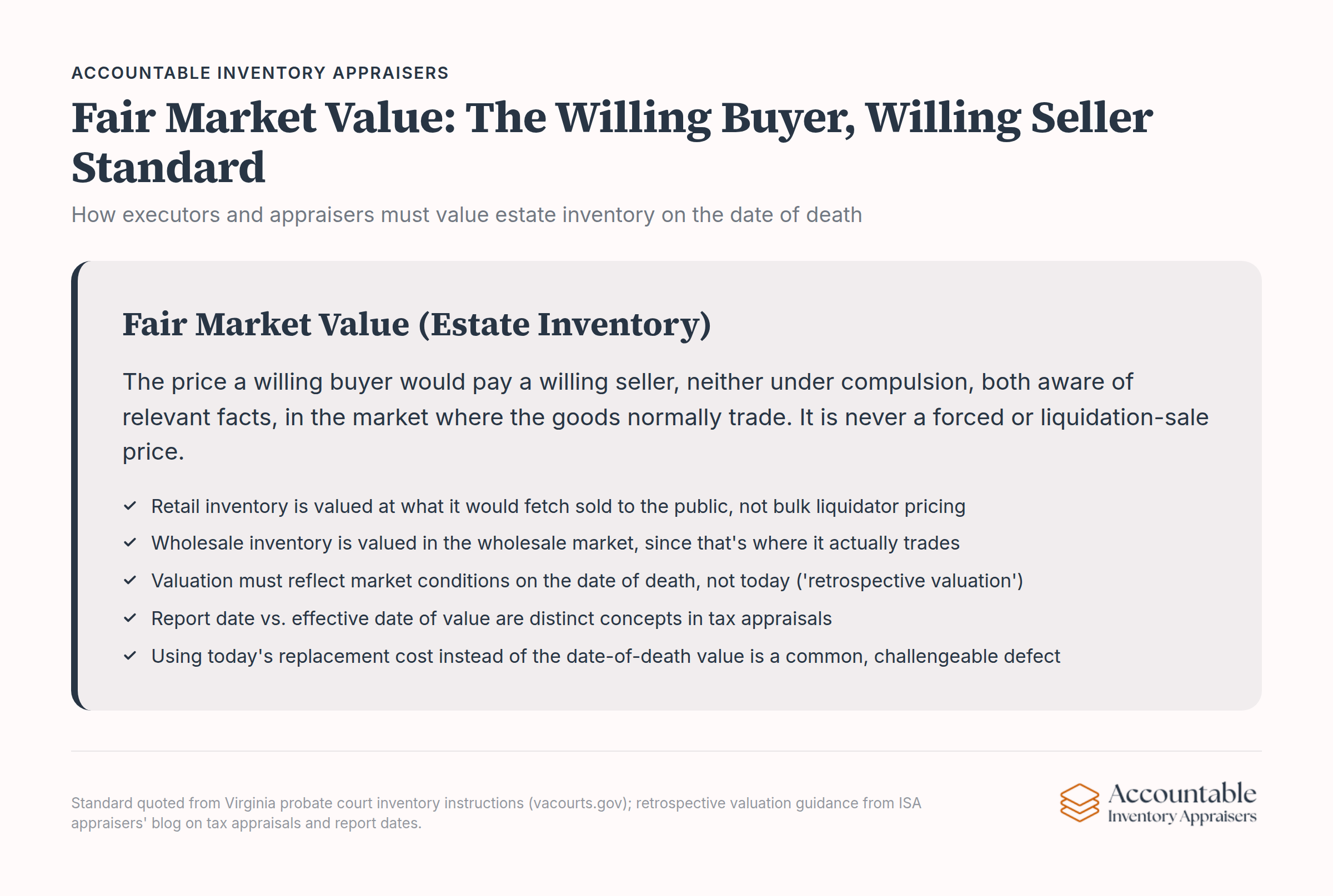
Fair market value for estate inventory is the price a willing buyer would pay a willing seller, with neither one under pressure and both aware of the relevant facts. It is never the price the inventory would bring at a forced or distress sale.
One state probate court's inventory instructions put the standard directly:
"The price at which the property would change hands between a willing buyer and a willing seller in the retail market, with neither one being under any compulsion to buy or to sell and both having reasonable knowledge of relevant facts." - Virginia probate court inventory instructions
That phrase, "in the retail market," matters. Fair market value has to reflect the market where the goods would normally change hands. Inventory sitting on the shelves of an operating retail store is generally valued based on what it would fetch sold to the public in the ordinary course of business, not what a liquidator would pay for the whole lot in bulk. A wholesaler's inventory, by contrast, is valued in the wholesale market, because that is where those goods actually trade.
Because the valuation date is fixed by law rather than by convenience, appraisers treat this as a retrospective valuation: the report is written today, but the opinion of value has to reflect market conditions as they existed on the date of death, not current conditions. Industry guidance on appraisal report dates describes this as the difference between the report date and the effective date of value, and it is a distinction appraisers working on tax appraisals apply routinely. Getting this wrong, by pricing inventory at today's replacement cost instead of researching what it was worth on the actual valuation date, is one of the more common defects in estate appraisals that get challenged.
What Form 706 Requires for Appraisals of High-Value Items
Form 706 does not accept a bare number for significant personal property or business inventory. The IRS Instructions for Form 706 require the executor to attach a copy of any appraisal obtained, along with a written explanation of the method used to value the property, whenever an appraisal was used to support the reported figure.
Separately, Treasury Regulation 20.2031-6(b) requires an expert appraisal made under oath, along with a statement of the appraiser's qualifications, for any single item of household or personal property, or any collection of similar items, valued at more than $3,000. Business inventory that includes valuable equipment, fine goods, or collectible stock can trip this threshold quickly even when the estate as a whole is modest.
Watch out: the $3,000 threshold applies per item or per collection of similar items, not to the estate's total inventory value. A single antique display case or a collection of similar hand tools worth $3,200 combined can trigger the sworn appraisal requirement even if the rest of the inventory is unremarkable.
Our appraisers hold credentials with organizations such as the ASA, ISA, and AAA, and every estate inventory report we prepare is written in accordance with USPAP, which is the standard framework these sworn appraisal requirements are built around.
Documentation Executors Should Gather Before the Appraisal
A supportable date of death inventory valuation depends on records, not just a walkthrough of the property. Executors should assemble the following before the appraiser's work begins:
- Physical or perpetual inventory counts as close to the date of death as possible, ideally the business's own year-end or point-of-sale count.
- Purchase records and invoices showing what the decedent paid for stock, which helps the appraiser separate cost from fair market value rather than confusing the two.
- Photographs of inventory in place, particularly for goods that may be sold, damaged, or discarded before the appraisal is completed.
- Any prior appraisals of the business or its inventory, even outdated ones, which help establish a valuation history.
- The death certificate and Letters Testamentary or Letters of Administration, which confirm the executor's legal authority to engage an appraiser and release records.
Gathering this material early keeps the appraisal on schedule and gives the appraiser the documentation needed to satisfy the explanation requirement in the Form 706 instructions.
Worked Example: Retail vs Wholesale Value for a Small Retailer's Inventory
Example: A decedent owned a small hardware store carrying $180,000 of inventory at cost on the store's books. The executor has two realistic paths forward, and each points to a different fair market value.
If the family keeps the store open and the inventory continues selling to walk-in customers at marked retail prices, fair market value is based on those retail selling prices, adjusted for a normal markdown reserve on slow-moving stock. That calculation lands around $215,000, higher than cost because retail pricing includes the store's normal markup.
If the family instead closes the store and sells the entire inventory in one lot to a liquidator or another retailer, the relevant market shifts to wholesale or bulk sale, because that is how the property would actually change hands under those circumstances. That path might produce a fair market value closer to $130,000, lower than cost because a single buyer taking the whole lot expects a discount.
The lesson is not that one number is right and the other wrong. It is that fair market value depends entirely on the market where the specific inventory would normally be sold given the actual facts of the estate, and an appraiser has to document which market applies before assigning a number.
How Estate Valuation Differs From Routine Inventory Accounting
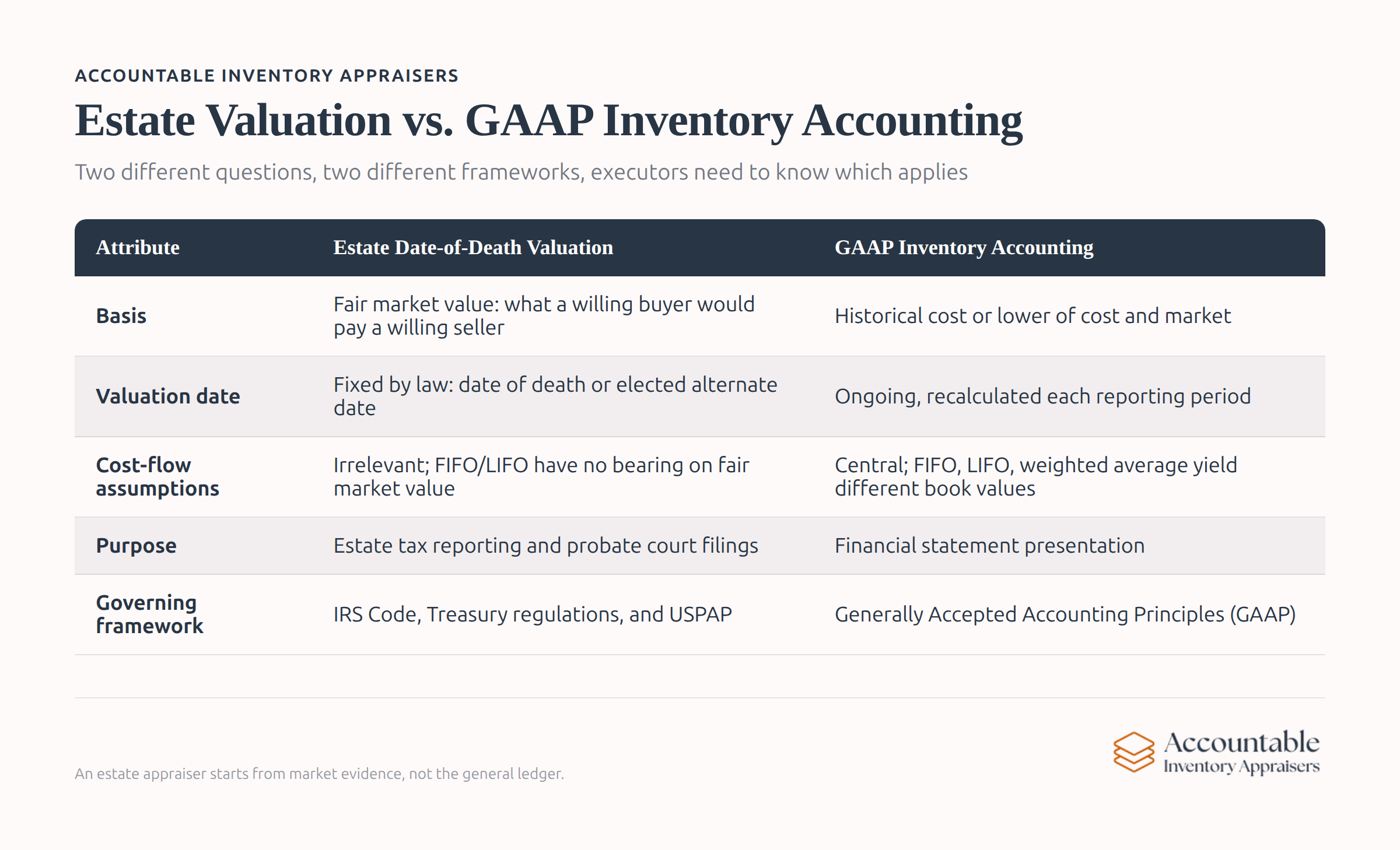
Executors and even some accountants sometimes assume the business's existing books already answer the valuation question. They do not. Estate inventory valuation and day-to-day inventory accounting answer two different questions using two different frameworks, as shown below.
| Attribute | Estate Date-of-Death Valuation | GAAP Inventory Accounting |
|---|---|---|
| Basis | Fair market value: what a willing buyer would pay a willing seller | Historical cost or the lower of cost and market |
| Valuation date | Fixed by law: date of death or the elected alternate date | Ongoing, recalculated at each reporting period |
| Cost-flow assumptions | Irrelevant; FIFO and LIFO have no bearing on fair market value | Central to the calculation; FIFO, LIFO, and weighted average all produce different book values |
| Purpose | Estate tax reporting and probate court filings | Financial statement presentation |
| Governing framework | The Internal Revenue Code, Treasury regulations, and USPAP | Generally Accepted Accounting Principles |
A retailer's LIFO reserve or a manufacturer's lower-of-cost-or-market write-down tells you something about that company's financial statements. It tells you nothing about what a willing buyer would actually pay for that inventory on the date the owner died. An estate appraiser starts from market evidence, not the general ledger.
Getting a Defensible Number Before the Return Is Filed
A date of death inventory valuation only holds up if it is built on the right valuation date, the correct fair market value standard, and documentation that matches what Form 706 and the applicable Treasury regulations require. Executors who wait until the return deadline to think about appraisal support usually end up scrambling for records that were easy to gather right after the date of death but difficult to reconstruct months later.
Our appraisers work directly with executors, estate attorneys, and CPAs to build reports that stand up to IRS review and probate court scrutiny, from small retail inventories to complex mixed business and personal property estates.
This article is provided for general informational purposes only and does not constitute legal, tax, or financial advice. Readers should consult a qualified attorney or CPA regarding their specific circumstances.