
Blog
Food Inventory Donation Appraisals and the IRS Rules Behind the Enhanced Deduction
Donating excess food inventory can trigger an enhanced deduction under IRC Section 170(e)(3), but the formula, the PATH Act eligibility rules, and the $5,000 qualified appraisal threshold each work differently than a standard inventory write-off. This guide walks through the math, who qualifies, and when a professional appraisal is actually required.
Restaurants, grocers, distributors, and manufacturers throw away enormous amounts of edible food every year, often because it is nearing its sell-by date or has minor cosmetic flaws that keep it off the shelf. Donating that inventory instead of discarding it can produce a meaningful tax deduction, but the IRS treats food inventory donations differently than a straightforward sale of goods. Businesses that get the math or the documentation wrong risk an inflated deduction that will not survive an audit, which is exactly where a proper inventory appraisal for charitable donation earns its cost.
This guide covers why businesses donate excess inventory, how the standard inventory deduction differs from the enhanced deduction under IRC Section 170(e)(3), how the PATH Act changed eligibility for non-C corporations, and when Form 8283 actually requires a qualified appraisal.
Why Restaurants, Grocers, and Distributors Donate Excess Food Inventory
Food businesses generate surplus inventory constantly. A grocer overstocks ahead of a holiday and ends up with cases that will not sell in time. A restaurant closes a menu item and has case goods left over. A manufacturer produces a run with cosmetic labeling errors that never touch the health or safety of the product itself.
Donating that inventory to a qualifying charitable organization keeps usable food out of landfills and, when documented correctly, produces a tax deduction that offsets the loss. The trade-off is that the IRS wants proof: what the inventory was, what it would have sold for, and why the business chose to donate it rather than sell it at a discount.
When Does a Food Inventory Donation Require a Qualified Appraisal?
A qualified appraisal is generally required for any single item or group of similar noncash donated property valued at more than $5,000, and it must be reported on Section B of IRS Form 8283. Inventory, however, carries a notable exception: property described under the tax code's ordinary-income inventory rules is generally excluded from the qualified appraisal requirement even when it drives a sizable deduction.
That exception does not eliminate the need for documentation. The IRS still requires Form 8283 to be attached to the return once total noncash contributions exceed $500, and a contemporaneous written acknowledgment from the receiving organization is required for any single gift of $250 or more. In practice, most food inventory donations skip the formal qualified appraisal but still need a defensible record of quantity, condition, and value at the time of the gift.
Watch out: Skipping the appraisal exception does not mean skipping the paperwork. Businesses that claim a large enhanced deduction without solid valuation support are the ones the IRS is most likely to challenge, because the deduction hinges entirely on an accurate fair market value at the date of donation.
Businesses that want the value locked down beyond dispute, particularly for larger donations or recurring donation programs, often still commission a professional inventory appraisal to document quantities, condition, and comparable pricing even when a qualified appraisal is not technically mandatory. Our related documentation checklist for inventory donation appraisals walks through exactly what a defensible file should contain.
The Standard Inventory Deduction vs the Enhanced Deduction Under IRC 170(e)(3)
Under the general rule, a business that donates inventory can deduct the item's fair market value minus the ordinary income the business would have recognized had it sold the item at that value. In plain terms, the standard deduction is roughly equal to the inventory's cost basis; the business does not get credit for the appreciation it never realized.
IRC Section 170(e)(3) changes that math for qualifying donations of apparently wholesome food. Instead of losing the appreciation, the business gets to claim part of it back, which is why the enhanced deduction almost always produces a larger number than the standard rule for food that has real market value above its cost.
| Feature | Standard Inventory Deduction | Enhanced Deduction (170(e)(3)) |
|---|---|---|
| Applies to | Any donated inventory | Apparently wholesome food inventory |
| Deduction basis | Roughly cost basis | Basis plus a share of appreciation |
| Qualified appraisal | Generally not required | Generally not required |
| Deduction cap | Business income limits apply | 15% of net income (non-C corp) or taxable income (C corp) |
How the Enhanced Deduction Formula Works
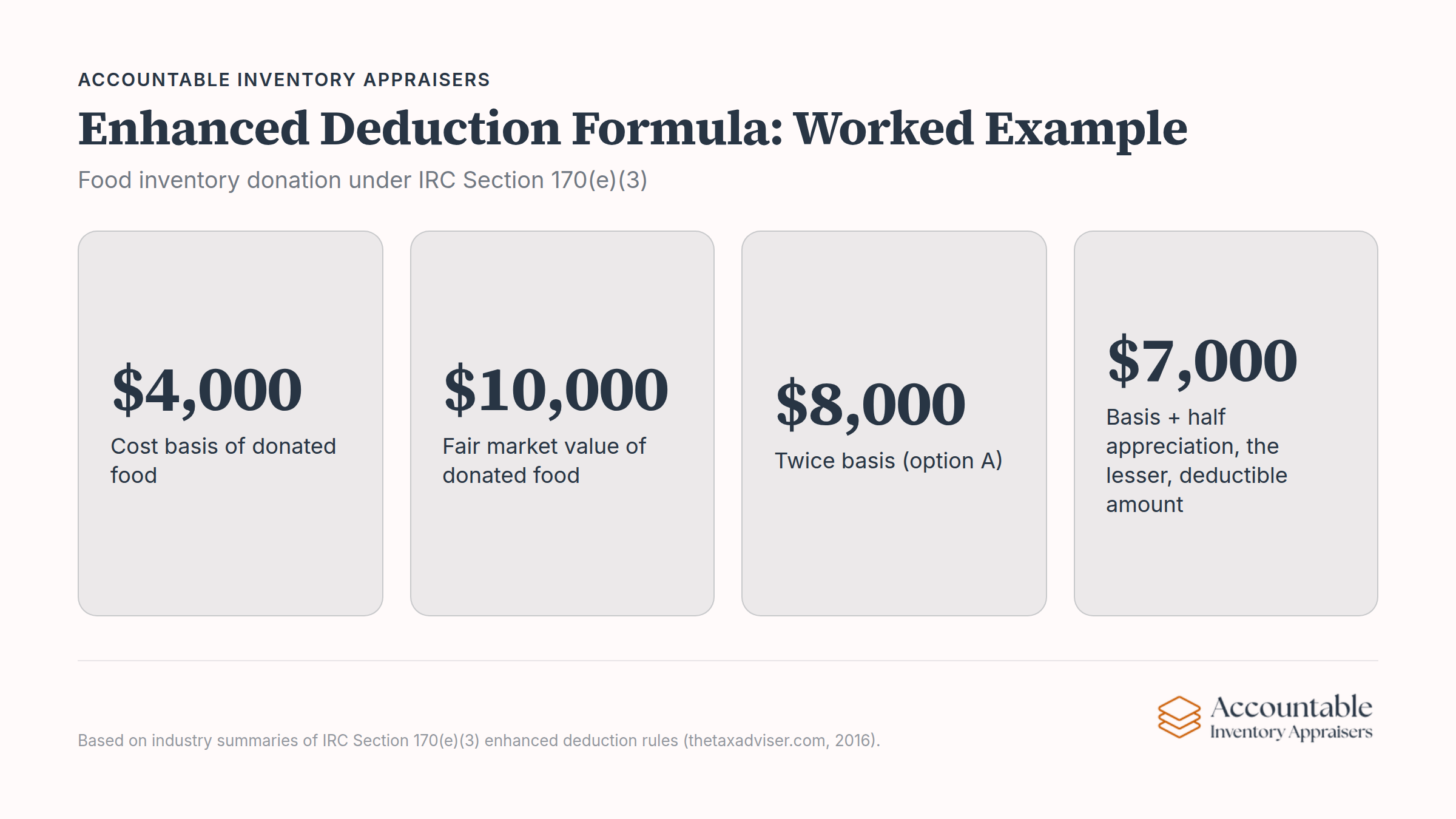
The enhanced deduction under IRC Section 170(e)(3) is calculated as the lesser of two amounts: twice the food's basis, or the basis plus one-half of the amount by which the food's fair market value exceeds basis. Industry guidance describes this as the smaller of "twice basis" or "basis plus half the appreciation," and the smaller figure is what the taxpayer actually claims, as detailed in industry summaries of the enhanced deduction rule.
Example: A distributor donates cases of shelf-stable food with a cost basis of $4,000 that would have sold for $10,000 at fair market value. Twice the basis is $8,000. Basis plus half the appreciation ($6,000 in appreciation, half of which is $3,000) equals $7,000. The lesser of the two, $7,000, is the deductible amount, well above the $4,000 the business would deduct under the standard inventory rule.
Pro tip: The formula rewards businesses that can document fair market value accurately. Without a credible FMV figure, there is no appreciation to claim, and the deduction collapses back to basis.
PATH Act Eligibility for Non-C Corporations
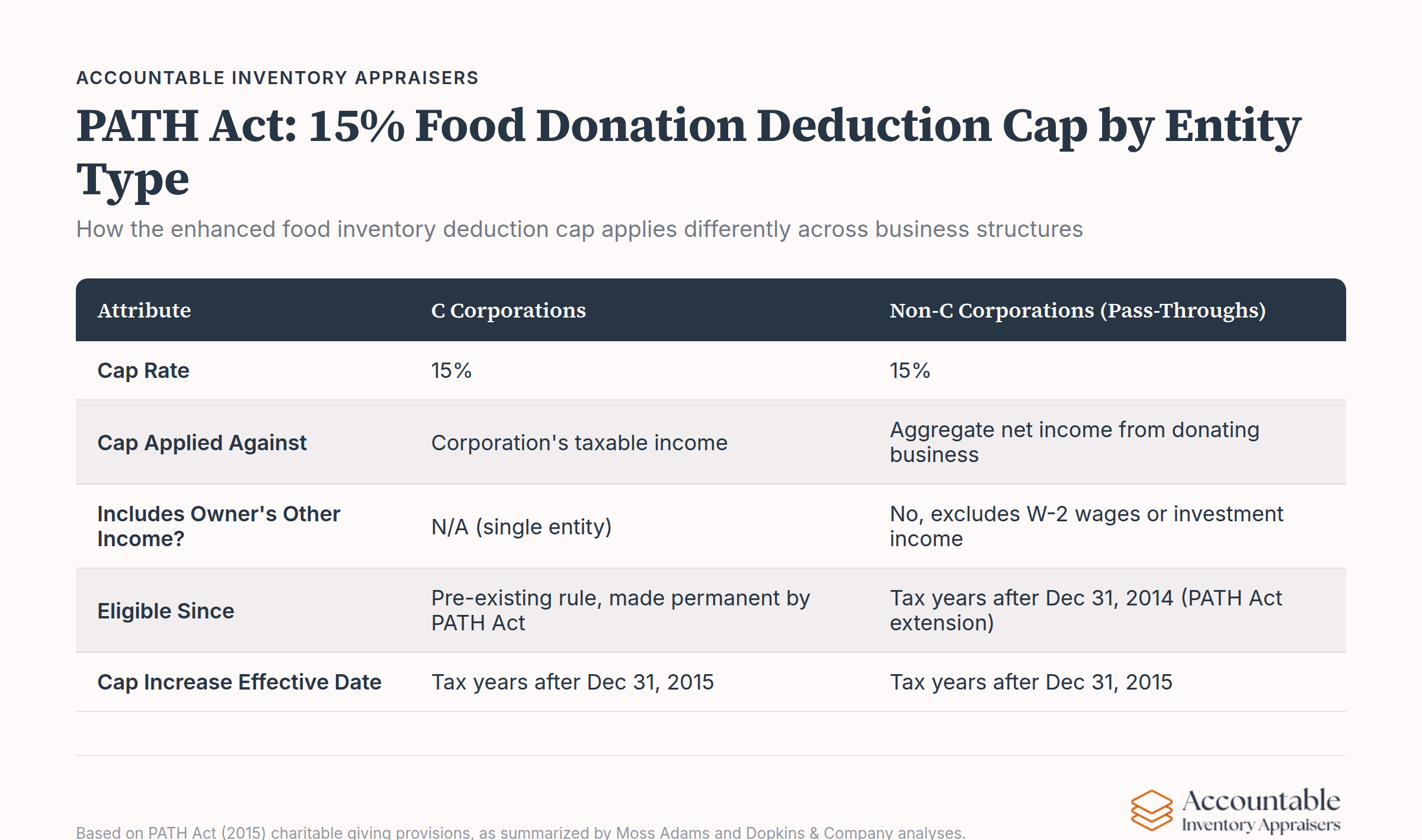
Before the Protecting Americans from Tax Hikes (PATH) Act of 2015, the enhanced food inventory deduction was available on a temporary, frequently expiring basis and its treatment for pass-through businesses was inconsistent. The PATH Act permanently extended the enhanced deduction and, critically, made it available to non-C corporation taxpayers, including sole proprietors, partnerships, and S corporations, for tax years beginning after December 31, 2014.
The PATH Act also raised the deduction cap for food inventory contributions from 10% to 15% of the taxpayer's relevant income figure, effective for tax years beginning after December 31, 2015, a change that applies across multiple business tax provisions affected by the Act. The cap works differently depending on entity type:
- C corporations: the 15% cap applies against the corporation's taxable income.
- Non-C corporations: sole proprietors, partnerships, and S corporations apply the 15% cap against the aggregate net income from the trade or business (or businesses) from which the food donation was made, not against the owner's total personal income.
That distinction matters for pass-through owners. A restaurant operated as an S corporation cannot stack its 15% cap against the owner's unrelated W-2 wages or investment income; the limit is tied specifically to the net income the food-donating business itself generates.
How Fair Market Value Is Determined for Donated Food Inventory
Fair market value for donated food inventory is generally determined by what the food would have sold for in the ordinary course of business, adjusted for its actual condition at the time of the gift. A case of canned goods three days from its sell-by date is not worth the same as a case with six months of shelf life left, and cosmetically damaged packaging that would normally move at a discount should be valued at that discounted price, not full retail.
Comparable sales data does most of the heavy lifting here: recent invoices, wholesale price lists, and the business's own discount or clearance pricing for similar near-expiration or blemished goods. General guidance on documenting these donations recommends keeping records that tie each donated lot back to a specific valuation source, as outlined in broader guidance on charitable donations of inventory.
Key takeaway: Fair market value for food inventory is not the shelf price on a good day. It is what the specific lot, in its specific condition, would actually have brought in a sale at the time it was donated.
Building a Defensible Food Inventory Donation Deduction
Even when the qualified appraisal exception applies, businesses that donate food inventory regularly, or that are claiming a deduction large enough to draw attention, benefit from an independent valuation that documents quantity, condition, and comparable market pricing at the date of the gift. A well-supported file makes the difference between a deduction that holds up and one that gets unwound during an examination.
Our appraisers hold credentials with organizations such as the International Society of Appraisers (ISA), the American Society of Appraisers (ASA), and the Certified Appraisers Guild of America (CAGA), and every inventory valuation is prepared in accordance with USPAP. Fees for an inventory appraisal are quoted as a fixed fee after we scope the assignment based on the number of SKUs, the completeness of existing records, and whether the report needs to meet IRS-qualified standards; published pricing for inventory engagements typically starts at $495 and runs higher for larger or more complex donation programs.
Getting the deduction right starts with getting the value right. If your business is planning a food inventory donation, or already has one under review, a documented, defensible valuation is worth building before the return gets filed, not after a notice arrives.
This article is provided for general informational purposes only and does not constitute legal, tax, or financial advice. Readers should consult a qualified attorney or CPA regarding their specific circumstances.