
Blog
How Lenders Use Inventory Appraisals to Set Asset-Based Lending Collateral Values
An inventory appraisal for asset-based lending gives lenders the net orderly liquidation value that sets your borrowing base advance rate, not a market value estimate. Here is how that number gets built, what documentation to prepare, and how often the appraisal gets refreshed over the life of the loan.
When a lender extends an asset-based facility secured by inventory, the loan amount is not built on what the goods cost to make or what they might sell for on a good day at retail. It is built on what an independent appraiser says the inventory would fetch in a forced, time-limited sale. If your finance team is preparing for a new asset-based lending (ABL) facility or a renewal, understanding how that appraisal drives your borrowing base changes how you prepare for it, and how you negotiate the terms that follow.
Why ABL Lenders Require a Third-Party Inventory Appraisal
Lenders require an independent appraisal because they need a number they did not produce themselves, one that stands up to examiner review and to a workout scenario. The OCC Comptroller's Handbook on asset-based lending directs banks to obtain an appraisal during underwriting to determine collateral value and establish the borrowing base, and to keep using appraisals afterward to monitor coverage as conditions change.
That expectation runs in both directions. Lenders want a defensible basis for the credit they extend, and borrowers benefit from a report that accurately reflects what their inventory is actually worth in a liquidation scenario rather than a haircut applied blind. Our inventory appraisal service for asset-based lending exists specifically to produce that independent, USPAP-compliant number for both sides of the transaction. If you are unfamiliar with how these engagements differ from a standard valuation, our guide on what an inventory appraisal actually involves is a useful starting point.
How Net Orderly Liquidation Value Sets the Borrowing Base
Most lender collateral appraisals are requested on the premise of orderly liquidation value: an opinion of what the inventory would realize if sold within a reasonable period to find a buyer, with the seller compelled to sell on an as-is, where-is basis as of a specific date. This is the premise lenders default to because it reflects what would actually happen if the borrower's business failed and the inventory had to be converted to cash under pressure, rather than sold at leisure in the ordinary course.
The appraised net orderly liquidation value (NOLV) becomes the input for the borrowing base formula. Eligible inventory, multiplied by an advance rate, plus eligible receivables multiplied by their own advance rate, minus reserves, produces the amount a borrower can draw. The OCC handbook describes the typical structure directly:
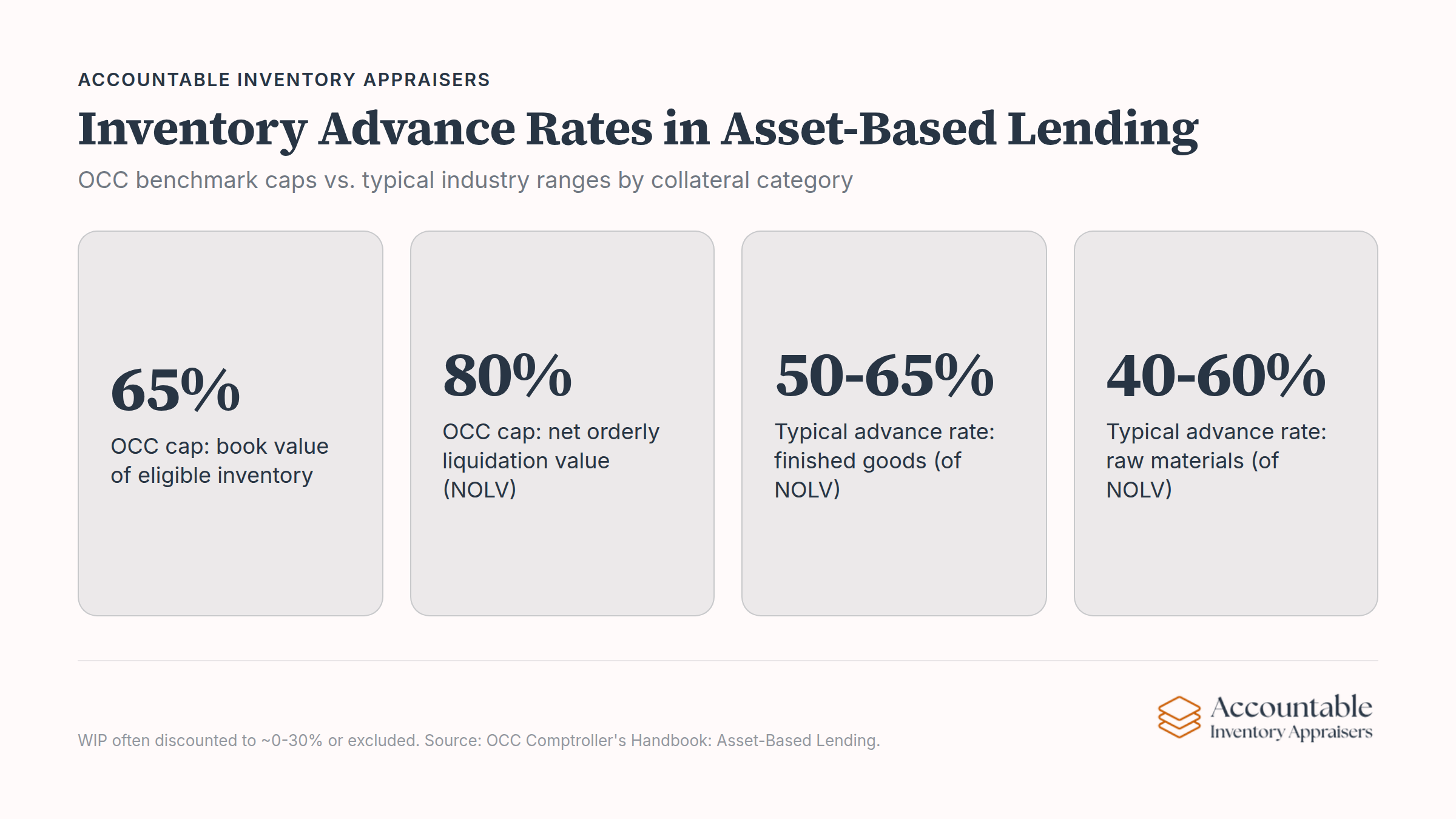
"A bank typically advances up to 65 percent of the book value of eligible inventory, or 80 percent of the net orderly liquidation value." - OCC Comptroller's Handbook: Asset-Based Lending
Many lenders apply the advance rate to whichever figure is lower, cost or appraised NOLV, so the appraisal functions as a ceiling as much as a floor. Industry advance rate ranges bear this out: finished goods commonly draw somewhere near 50 to 65 percent of NOLV, raw materials trend lower at roughly 40 to 60 percent, and work-in-process is often discounted heavily or excluded entirely because it has no ready buyer in a forced sale, according to lender-side ABL advance rate guidance. A borrowing base explainer from Alterest breaks this out similarly by collateral category, with work-in-process sitting near zero to 30 percent of value.
Gross Value vs Net Value: Why the Distinction Matters
Gross liquidation value and net liquidation value are not the same number, and confusing them is one of the most common mistakes borrowers make when reading their own appraisal report. Gross value is what the inventory would generate in total sale proceeds. Net value takes that gross figure and deducts the actual cost of running the liquidation sale.
Those deductions typically include:
- Occupancy costs: rent, utilities, and security for the warehouse or retail space during the sale period.
- Logistics expenses: freight, handling, and re-packaging needed to move goods to buyers.
- Selling and commission expenses: fees paid to a liquidation firm or auctioneer to run the sale, plus advertising costs to attract buyers.
Lenders lend against the net figure because that is what actually reaches them after a real liquidation event, not the gross number before those costs are paid. A borrower who only reads the gross value line in an appraisal report and compares it to their loan balance is comparing the wrong two numbers. Ask your appraiser to walk through both figures and the specific deductions applied, since those deductions vary meaningfully by inventory type, geography, and how quickly the sale needs to happen.
What Documentation Borrowers Should Prepare Before the Appraisal
Key takeaway: the appraisal moves faster and produces a more defensible NOLV when the borrower arrives with clean, current records rather than reconstructing them mid-engagement.
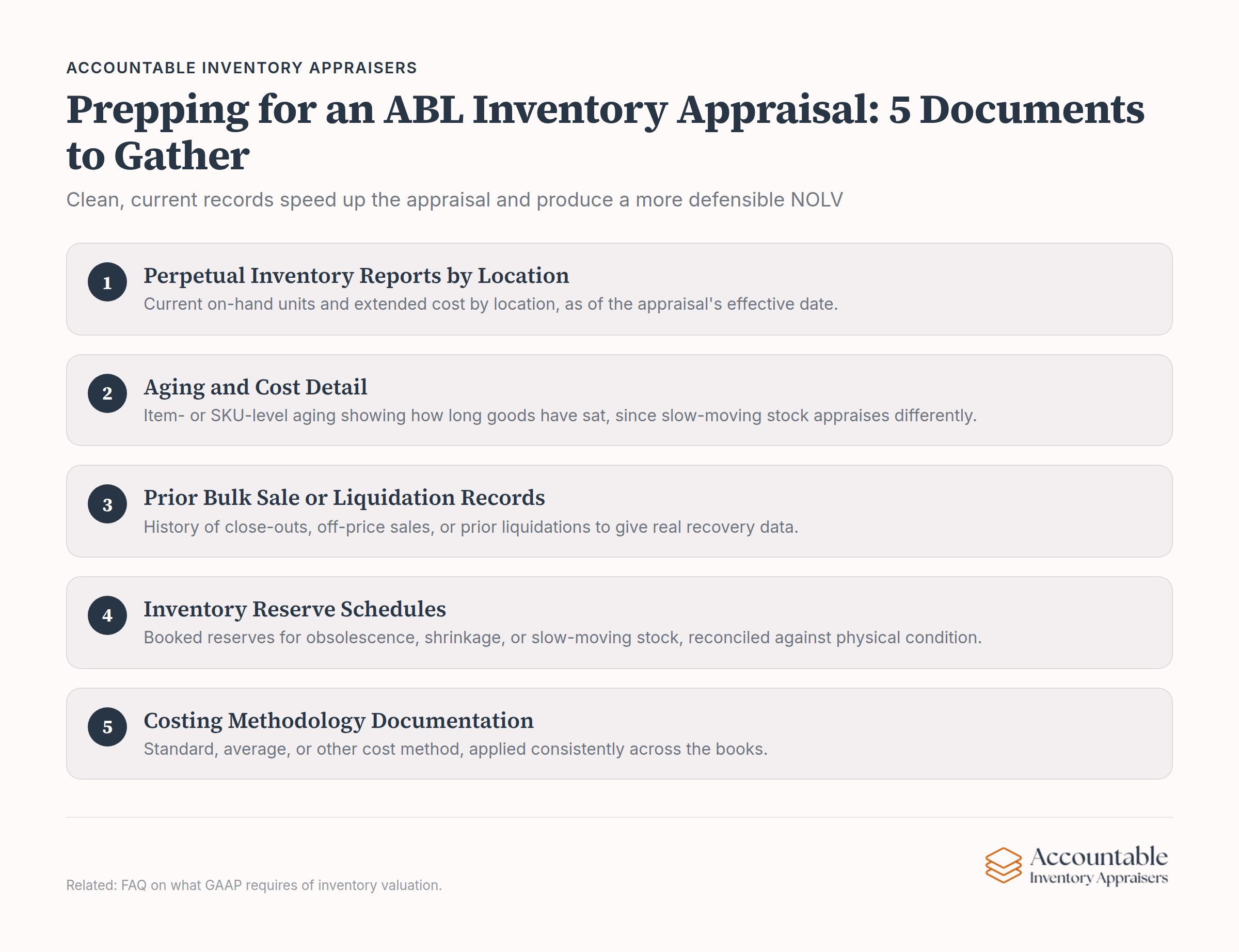
An appraiser working on an ABL engagement needs to understand not just what inventory exists, but how it is tracked, aged, and costed. Before the appraiser's first site visit or data request, finance teams should assemble:
- Perpetual Inventory Reports by Location
- A current, location-by-location listing of on-hand units and extended cost, ideally as of the appraisal's effective date rather than a stale month-end close.
- Aging and Cost Detail
- Item-level or SKU-level aging that shows how long goods have sat on hand, since slow-moving and obsolete stock gets appraised differently than fast-turning inventory.
- Prior Bulk Sale or Liquidation Records
- Any history of close-out sales, off-price channel sales, or prior liquidation events for similar goods, which gives the appraiser real recovery data rather than pure estimation.
- Inventory Reserve Schedules
- The reserves already booked for obsolescence, shrinkage, or slow-moving stock, which the appraiser will reconcile against the physical condition and marketability findings.
- Costing Methodology Documentation
- Whether the company uses standard cost, average cost, or another method, and how that methodology has been applied consistently. Our FAQ on what GAAP requires of inventory valuation covers how costing methodology choices show up on the balance sheet before they ever reach an appraiser's desk.
Gathering this material up front is not busywork. A lender's field examiner will ask for the same records to test the appraiser's conclusions, and gaps between what the appraisal assumed and what the borrower's own systems show is exactly the kind of discrepancy that gets a facility's advance rate cut mid-term.
How Often Do Appraisals Get Updated Over the Life of the Loan?
An inventory appraisal for an ABL facility is not a one-time event performed only at closing. Lenders commission updated appraisals periodically throughout the life of the loan to confirm that the borrowing base still reflects reality, and the frequency of those updates tracks the risk in the relationship rather than a fixed calendar.
A borrower with stable inventory, consistent margins, and a long track record with the lender may see a refreshed appraisal every 12 to 18 months. A borrower in a volatile category (fashion goods, technology hardware, or anything with fast obsolescence), or one showing covenant stress, declining sales, or a shift in inventory mix, should expect more frequent updates, sometimes annually or even more often if the lender's risk rating on the account changes. Field exams between full appraisals help lenders spot early warning signs and decide whether an out-of-cycle appraisal is warranted before the next scheduled one.
Watch out: a lapse between your last appraisal and a covenant test or facility renewal can leave you negotiating off a stale NOLV that no longer reflects current inventory mix or market conditions. Raising the question of timing with your lender before it becomes a problem is far better than discovering it during a borrowing base certificate dispute.
USPAP Compliance and the Retrospective Appraisal Standard
Many ABL inventory appraisals are prepared as of a past date rather than the date the appraiser walks the floor, which makes them retrospective appraisals under professional appraisal standards. This comes up often when a lender needs a value as of a fiscal quarter-end or a specific loan covenant date that has already passed by the time the engagement is scoped.
A retrospective appraisal must still conform to the Uniform Standards of Professional Appraisal Practice (USPAP), published by The Appraisal Foundation, just as a current-date appraisal would. The appraiser reconstructs conditions as they existed on the effective date, drawing on the perpetual inventory records, aging reports, and costing documentation described above, rather than simply describing what is on hand at the time of inspection. Appraisers working in this space typically hold credentials such as ASA, ISA, or CAGA designations, and a well-prepared retrospective report should clearly distinguish the effective date of value from the date the report itself was written.
For borrowers, the practical implication is that documentation quality matters even more in a retrospective engagement, because the appraiser cannot simply observe current conditions and extrapolate backward. Records that tie inventory levels, costs, and reserves to the specific date in question make the difference between a defensible retrospective conclusion and one built on assumptions.
Preparing Your Finance Team for the Appraisal Conversation
An ABL inventory appraisal touches accounting, operations, and treasury all at once, which means the finance team preparing for it should expect questions that go beyond a simple inventory count. Lenders and their appraisers want to understand sell-through history, channel mix, seasonality, and how quickly goods could realistically move in a forced sale, not just what the general ledger says the inventory is worth.
Engagements of this kind are scoped individually and quoted as a fixed fee once the appraiser understands the number of locations, SKU complexity, and reporting requirements involved. There is no hourly billing and no surprise invoice once the scope is set. Our appraisers prepare these reports in accordance with USPAP and structured to meet the documentation standards lenders and their examiners expect, so the number that lands in your borrowing base calculation holds up under scrutiny from underwriting through renewal.
This article is provided for general informational purposes only and does not constitute legal, tax, or financial advice. Readers should consult a qualified attorney or CPA regarding their specific circumstances.