
Blog
IRS Inventory Donation Appraisal Requirements: A Documentation Checklist for Businesses
Donating inventory to charity comes with its own IRS documentation rules, separate from the usual $5,000 appraisal trigger. This checklist walks through what records to keep, how Form 8283 treats inventory differently, and why fair market value documentation still matters even when a qualified appraisal isn't strictly required.
Donating excess or discontinued inventory to charity can be a smart move for a business: it clears warehouse space, supports a good cause, and generates a tax deduction. But inventory donations follow a different set of IRS rules than donations of other personal property, and getting the documentation wrong can mean losing the deduction entirely or inviting a harder look from the IRS. This guide walks through exactly what records a business needs to substantiate an inventory donation, how Form 8283 treats inventory differently from other property, and why professional valuation documentation still matters even in the cases where a formal qualified appraisal isn't strictly mandated.
Many businesses turn to a dedicated inventory appraisal for charitable donation precisely because the fair market value and cost basis calculations get complicated fast, and a defensible number matters more than a rough estimate once the IRS is involved.
What Counts as an Inventory Donation for IRS Purposes
Inventory, for this purpose, is property your business holds for sale to customers in the ordinary course of business, not equipment, real estate, or personal-use property. That distinction matters because inventory donations are governed by a specific set of rules under IRC Section 170(e) that differ from the rules for donating art, collectibles, or other personal property.
When inventory is contributed, the deduction is generally limited to the smaller of the item's fair market value on the date of donation or its cost basis, according to the IRS Instructions for Form 8283. This is different from a typical appraised-property donation, where the full fair market value is usually deductible. The rule exists because donating inventory would otherwise let a business convert what would have been ordinary business income into a charitable deduction at full market value, and the tax code specifically limits that.
Our guide to how ordinary income property is appraised for donation deductions covers the mechanics of this limitation in more depth, but the short version is this: the deduction is reduced by the amount of gain that would have been ordinary income had the inventory been sold instead of donated. For most inventory, that means the deduction caps out at cost, not fair market value.
The Records Checklist: What to Document Before You Donate
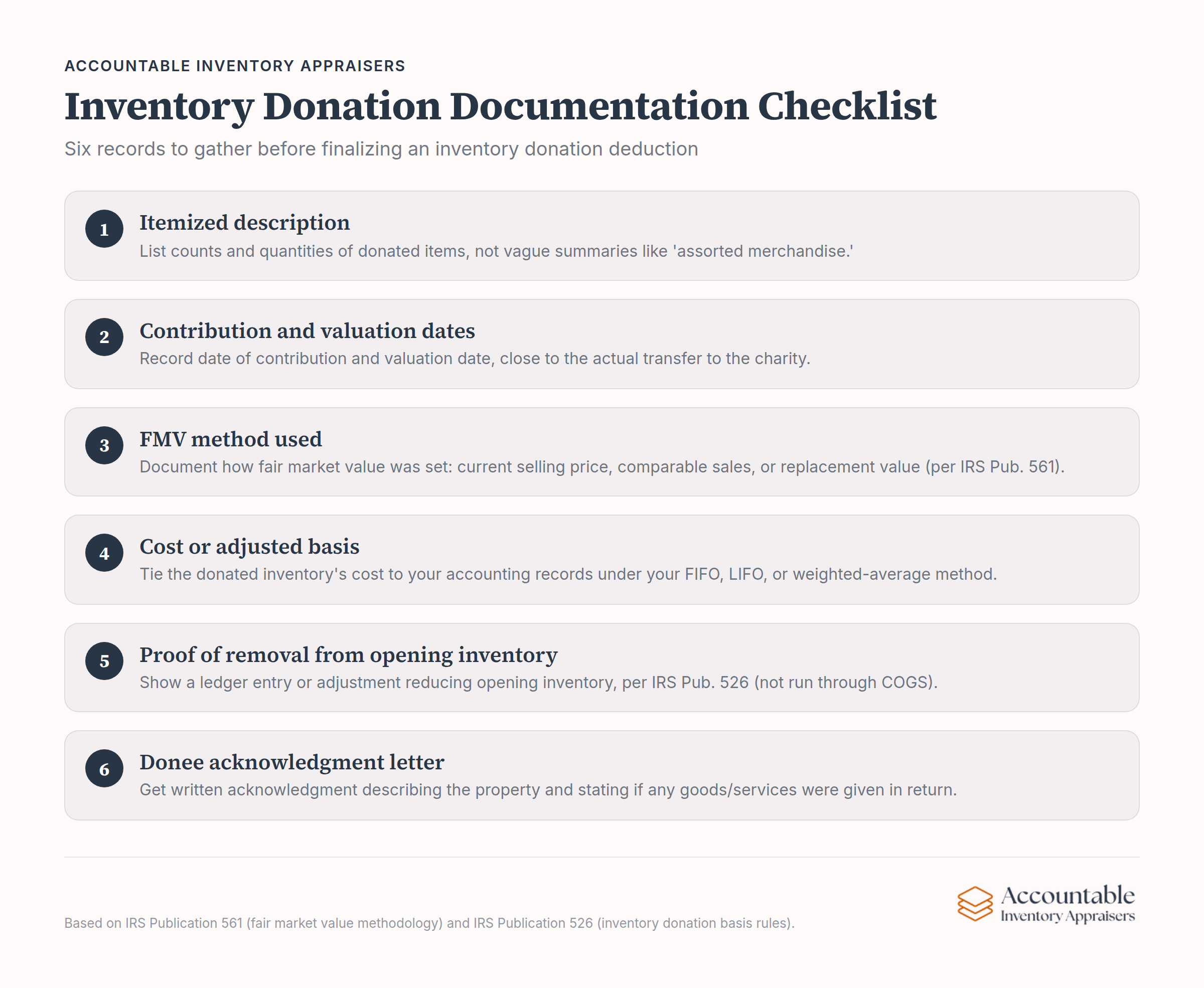
A defensible inventory donation deduction rests on records that connect the item, its cost, its value, and its removal from your books. Before you finalize a donation, your file should include the following:
- An itemized description of the donated property, including item counts and quantities, not a vague summary like "assorted merchandise."
- The date of contribution and the valuation date used, which should match or be reasonably close to the actual transfer of the goods to the charity.
- The method used to determine fair market value, whether that is current selling price, comparable sales of similar goods, or a replacement value approach, per the methodology outlined in IRS Publication 561.
- The cost or adjusted basis of the donated inventory, tied to your accounting records under whatever inventory costing method your business uses (FIFO, LIFO, or weighted average).
- Evidence the items were removed from opening inventory, such as an inventory ledger entry or adjustment showing the reduction, since IRS Publication 526 requires the donated amount to come out of opening inventory rather than being run through cost of goods sold.
- A written acknowledgment from the donee organization, describing the property received and stating whether the charity provided any goods or services in return.
Watch out: If the donated inventory's cost was never actually included in your opening inventory for the year, your basis is zero and Publication 526 does not allow a deduction based on fair market value in its place. This is a common trap for businesses that donate goods purchased and expensed in the same year.
Form 8283: Section A vs. Section B for Inventory Donations
Form 8283 splits noncash charitable contributions into two sections, and which one applies depends on the dollar amount and, for most property types, whether a qualified appraisal is required. The Form 8283 instructions lay out the split clearly.
| Section A | Section B | |
|---|---|---|
| Applies to | Deductions of $5,000 or less per item or group of similar items; publicly traded securities regardless of amount | Deductions over $5,000 per item or group of similar items |
| Appraisal required | No | Generally yes, a qualified appraisal by a qualified appraiser |
| Signatures required | None beyond the taxpayer | Appraiser's signed declaration (Part III) and the donee's signed acknowledgment (Part V) |
| Attachment to return | Not required | The qualified appraisal itself must be attached if the claimed deduction for an item or group exceeds $500,000 |
Most inventory donations, even large ones, stay in Section A because of the carve-out described below. But businesses should still track the total value of similar items donated during the tax year, since the IRS Publication 561 aggregation rule requires similar items to be added together when determining whether a threshold applies, not evaluated item by item in isolation.
Why the Inventory Carve-Out Doesn't Mean You Skip Documentation
Inventory contributed under Section 170(e)(3) is generally exempt from the Section B qualified-appraisal mandate, staying in Section A even when the total value clears $5,000, because the deduction is already capped at the lesser of fair market value or cost basis. In plain terms: the IRS built a limit into the deduction calculation itself, so it doesn't also demand the formal appraisal machinery that applies to appreciated property like art or collectibles.
That carve-out is a relief on the compliance-form side, but it is not a reason to skip valuation documentation altogether. Two situations make professional-grade documentation worth having anyway:
- The enhanced deduction for certain inventory contributions. Section 170(e)(3) allows some businesses, notably C corporations donating inventory that will serve the ill, needy, or infants, to claim a deduction above straight cost. Computing that enhanced amount correctly requires a defensible fair market value determination, not a guess.
- Surviving an IRS challenge to the FMV-versus-basis comparison. Even when the deduction is capped at basis, the IRS can still question whether your basis figure and your FMV figure were calculated correctly. Documentation that shows exactly how each number was reached, and that the items were actually removed from opening inventory, is what stands between your deduction and a disallowance.
Key takeaway: The absence of a Section B trigger removes a form requirement, not the underlying need to prove your numbers. A business claiming a large inventory deduction benefits from the same rigor a formal appraisal would provide, whether or not the box is technically checked.
Many businesses solve this by commissioning a professional inventory appraisal even when Section B doesn't strictly apply, simply because the resulting documentation holds up better under review than an internal spreadsheet.
The 60-Day Timing Window for Qualified Appraisals
When a qualified appraisal is used, whether because Section B applies to mixed donations or because a business wants appraisal-grade support for an inventory FMV calculation, timing matters. IRS Publication 561 requires the appraisal to be signed and dated no earlier than 60 days before the date of the contribution, and no later than the due date, including extensions, of the return on which the deduction is first claimed.
Example: A business donates inventory on June 1. An appraisal dated April 10 falls within the 60-day window and would be acceptable. One dated February 1 would not, because it falls outside that window.
Pro tip: Building the appraisal or valuation documentation into your donation planning, rather than reaching for it after the fact when a tax preparer asks for support, keeps you inside this window without a scramble at filing time.
Common Mistakes That Trigger IRS Scrutiny
A few recurring errors show up in inventory donation deductions that get challenged:
- Valuing at retail price instead of a defensible FMV. Listing the full shelf price for obsolete, discontinued, or damaged goods overstates value and invites a reduction on audit.
- Failing to remove donated items from opening inventory. If the ledger still shows the goods as on-hand stock, the deduction has no basis support.
- Treating similar items as separate small donations to dodge aggregation. The IRS aggregation rule combines similar items given in the same tax year, so splitting a donation across multiple dates or descriptions does not avoid the threshold calculation.
- Skipping the donee acknowledgment. Even when a formal appraisal isn't required, a written statement from the charity describing what it received is part of the substantiation record.
- Assuming the inventory carve-out means no documentation is needed at all. As covered above, the carve-out affects the form requirement, not the underlying burden of proof.
Building a Defensible File Before You File
Inventory donations reward businesses that document as they go: item counts and descriptions, cost basis tied to accounting records, the valuation method used, the date of contribution, and the donee's written acknowledgment. Even where Section B and a formal qualified appraisal don't apply, that same discipline is what keeps a large deduction standing if the IRS ever asks how the numbers were reached.
Our appraisers prepare fair market value and cost basis documentation for inventory donations of any size, built to hold up whether the filing lands in Section A or Section B. If your business is planning a donation and wants that documentation in place before the return is filed, request an appraisal to get started.
This article is provided for general informational purposes only and does not constitute legal, tax, or financial advice. Readers should consult a qualified attorney or CPA regarding their specific circumstances.