
Blog
How LIFO Layers Affect Your Charitable Donation Basis for Inventory Gifts
Donated inventory is generally deductible at tax basis, not fair market value, and which LIFO layer you draw down can change how large that basis is. This guide walks through the basis-cap rule, the FIFO versus LIFO contrast, and the cost-of-goods-sold adjustment accountants often miss.
When a business donates excess inventory to a charitable organization, the deduction is rarely the sticker-price fair market value of the goods. It is capped at the company's tax basis in those goods, and for a business using the LIFO method, which layer of cost gets assigned to the donated units can swing the size of that deduction considerably. Getting this wrong is one of the more common mistakes we see when businesses donate inventory, so this post walks through the mechanics step by step.
Why Donated Inventory Is Capped at Basis, Not Fair Market Value
Inventory is ordinary-income property under the tax code, meaning it is held primarily for sale to customers rather than as a long-term capital asset. If a business sold that inventory at fair market value, the resulting gain would be ordinary income, not capital gain.
Section 170 of the Internal Revenue Code requires a donor to reduce an otherwise fair-market-value charitable deduction by the amount of gain that would not have been long-term capital gain had the property been sold at fair market value on the contribution date. Because a sale of inventory produces ordinary income rather than capital gain, this reduction effectively strips out the entire appreciation built into the inventory's value. The practical result: for most inventory donations, the allowable deduction ends up equal to the company's tax basis in the goods, not their fair market value.
This is a different outcome than donors often expect when they are used to thinking about appreciated stock or real estate, where the full fair market value is typically deductible. Inventory does not get that treatment.
Our inventory appraisal for charitable donation engagements exist to document the fair market value side of this equation with a USPAP-compliant report. The basis side, which ultimately caps the deduction, comes from the company's own tax accounting records and is calculated by the donor's accountant, not the appraiser.
How the Basis Rule Ties to Your Accounting Method
The governing regulation is direct about where basis comes from: the basis of contributed inventory must be determined under the donor's own method of accounting for inventory for federal income tax purposes. Treasury Regulation 1.170A-4A states that the donor must use, as the basis of the contributed item, the inventoriable carrying cost assigned to a similar item that is not included in closing inventory.
In plain terms, whatever method the business already uses to value inventory on its balance sheet (FIFO, LIFO, or another recognized method) is the same method that determines what "basis" means for the donated units. A company cannot switch to a more favorable valuation method just for the purposes of a donation. The method has to be the one already in consistent use for tax reporting.
Key takeaway: The appraiser's job is to establish what the donated inventory is worth. The accountant's job is to tell the appraiser, and ultimately the IRS, what the company's tax basis in those same units actually is, using the company's existing inventory accounting method.
FIFO vs LIFO: The Layer Invasion Election
This is where the FIFO and LIFO methods diverge in a way that matters for the size of the deduction.
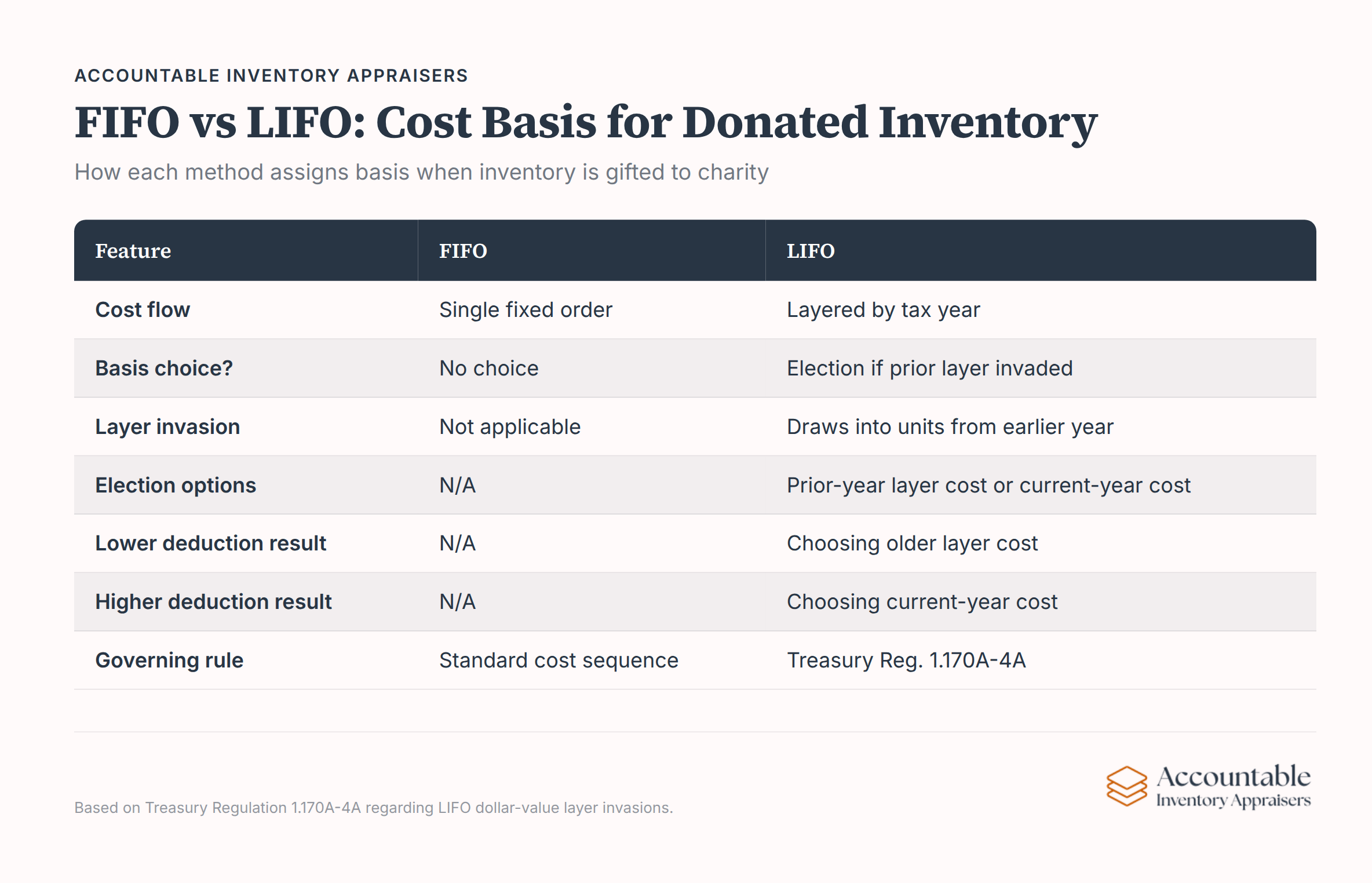
Under FIFO (first-in, first-out), cost flows in a single fixed order. The earliest costs recorded on the books are treated as the cost of the goods sold, or donated, first. There is no choice involved: the inventoriable carrying cost assigned to a donated item is simply whatever unit cost sits next in that first-in sequence.
Under LIFO (last-in, first-out), inventory is accounted for in layers, with a new layer added for each tax year's purchases or production. If current-year activity, including a donation, draws down into units that were actually added in an earlier year, that is called invading a prior year's layer. Treasury Regulation 1.170A-4A specifically addresses this situation: where there has been an invasion of a prior year's layer under the LIFO dollar-value method, the donor may choose to treat the contributed item as having a basis referencing the cost of the prior year's layer or layers, or referencing current-year cost.
That is a real election, and it matters because older LIFO layers are frequently carried at lower unit costs than current-year costs in an inflationary environment. Choosing the older layer cost generally produces a lower basis and a smaller deduction; choosing current-year cost generally produces a higher basis and a larger deduction. FIFO filers never face this choice because there is only one cost sequence to draw from.
Walking Through the Math: Fair Market Value vs Basis
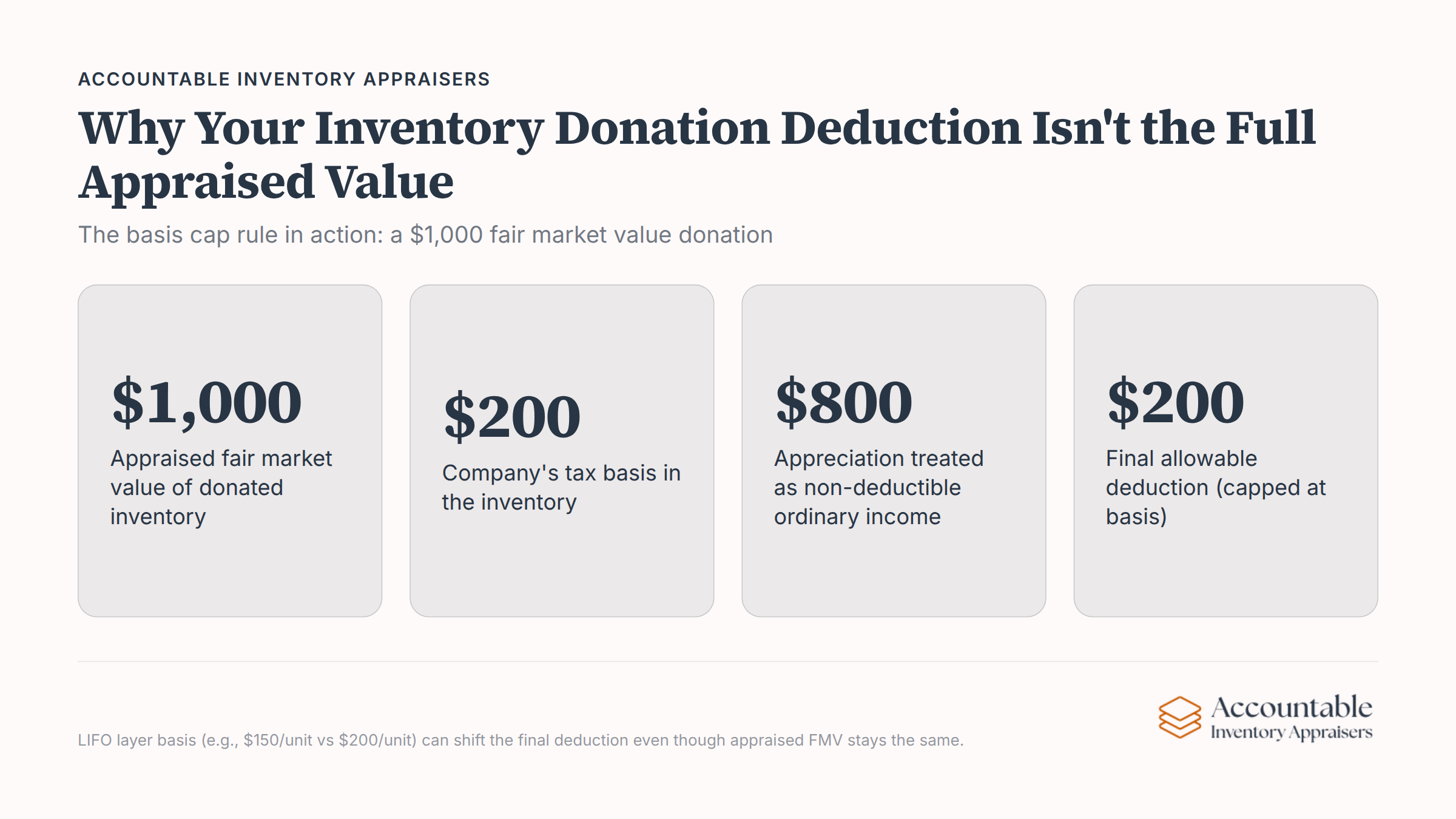
A simple illustration makes the mechanics concrete. Suppose a company contributes inventory with a fair market value of $1,000 and a tax basis of $200 in those same goods.
Under the general rule, the company must reduce its deduction by the gain that would not have been long-term capital gain had it sold the inventory at fair market value. Since the full $800 of appreciation ($1,000 fair market value minus $200 basis) would have been ordinary income on a sale, that entire amount is subtracted from the deduction. The result: the allowable deduction is $200, the same as the company's basis, not the $1,000 fair market value documented in the appraisal.
Example: If that same company were using LIFO and the donated units came from an older layer carried at $150 per unit rather than a current-year layer carried at $200 per unit, the allowable deduction would track whichever layer basis the company elects under the regulation, changing the final number even though the appraised fair market value stays at $1,000.
This is exactly why an appraiser needs to understand a company's accounting method and LIFO layer treatment before finalizing a report. The appraisal supports the fair market value side of the calculation. The accountant applies the basis cap using the cost records specific to the method the business actually uses.
The Cost of Goods Sold Adjustment Most Donors Miss
There is a second mechanic in this regulation that is easy to overlook. Beyond capping the deduction at basis, Treasury Regulation 1.170A-4A also requires the donor to decrease cost of goods sold for the year of the contribution by the basis amount used in the deduction.
In other words, the basis dollars claimed as a charitable deduction cannot also sit inside cost of goods sold on the income statement. IRS Publication 526 reinforces this point for inventory that was part of the donor's opening inventory for the year: the amount must be removed from opening inventory and is not treated as cost of goods sold. If the inventory's cost was never included in opening inventory in the first place, the regulation treats its basis as zero, meaning no deduction is available for that cost at all.
Accountants preparing the return need to coordinate this adjustment with whoever is tracking cost of goods sold, since missing it can result in effectively double-counting the same dollars, once in the deduction and once in operating expenses.
The Narrower Enhanced Deduction Under Section 170(e)(3)
The basis-cap mechanics above are the general rule for most inventory donations. There is a separate, narrower provision worth knowing about so it is not confused with the general rule.
Section 170(e)(3) of the Internal Revenue Code allows certain C corporations donating inventory to a qualifying charitable organization, for the care of the ill, needy, or infants, to claim a deduction that exceeds basis, up to basis plus half of the appreciation, capped at twice basis. This enhanced deduction comes with its own statutory conditions, including that the property be used by the donee in a manner related to its exempt purpose, along with specific substantiation requirements.
Most businesses donating surplus inventory do not qualify for this enhanced rule. It applies to a specific category of corporate donor and a specific category of recipient use. The general basis-cap rule under Section 170(e)(1)(A) described above is what governs the typical inventory donation, and it is the rule most donors and their accountants need to plan around.
When You Need a Qualified Appraisal
The appraisal requirement runs on fair market value, separate from the basis calculation. When the claimed deduction for donated property, aggregated across similar items, exceeds $5,000, the donor generally needs a qualified appraisal and must complete Section B of Form 8283. Once the claimed deduction reaches $500,000, the full appraisal report must be attached to the return.
This is where our appraisers come in. We establish the fair market value of the donated inventory as of the contribution date, prepared in accordance with USPAP, and our team holds credentials with organizations including the ISA, ASA, CAGA, and AAA. We do not calculate your basis or prepare your tax return. That work belongs to your accountant, using the company's own inventory accounting records and whichever method, FIFO, LIFO, or another recognized approach, the business already uses.
For a standard inventory donation appraisal, our fee is quoted as a fixed amount after we scope the assignment, generally starting from $495, with typical engagements running $695 to $3,500 depending on the number of items, the quality of existing records, and the depth of analysis required. Larger or more complex inventories can run higher. We quote every engagement as a fixed fee before work begins; we never bill by the hour.
Before you finalize a donation, it is worth having your accountant pull the specific LIFO layer history or FIFO cost sequence for the units you intend to give, and having that documentation ready when our appraisers scope the valuation. The two pieces, fair market value and tax basis, have to work together to support the deduction you actually claim. For businesses navigating documentation requirements more broadly, our IRS inventory donation documentation checklist and our explanation of the LIFO conformity rule cover related pieces of this same compliance picture.
This article is provided for general informational purposes only and does not constitute legal, tax, or financial advice. Readers should consult a qualified attorney or CPA regarding their specific circumstances.