
Blog
Orderly Liquidation Value in Inventory Appraisal: How it Differs From Fair Market Value
Orderly liquidation value assumes a seller compelled to sell inventory within a limited but reasonable window, while fair market value assumes no such pressure. This guide explains how the two premises differ, why lenders default to orderly liquidation value for inventory collateral, and how the dollar conclusion changes between them.
Inventory sitting on a company's books is rarely worth the same number to every reader of an appraisal report. A lender evaluating collateral, a bankruptcy trustee planning a wind-down, and a business owner filing an insurance claim are each asking a different question, and the appraiser has to answer with a different premise of value for each one. Orderly liquidation value (OLV) is the premise built for situations where a seller is under some obligation to sell inventory within a defined, limited period. Understanding how it diverges from fair market value (FMV), and from the even more compressed forced liquidation value (FLV), is essential for anyone relying on an inventory appraisal for a lending decision, a distressed sale, or a workout.
When inventory is pledged as collateral for a loan, the lender almost always wants to know what that inventory would fetch under liquidation conditions, not what it would sell for in the ordinary course of business. That distinction drives everything else in this article.
What Is Orderly Liquidation Value for Inventory?
Orderly liquidation value is an appraisal opinion of the gross proceeds inventory could typically generate in a properly managed, advertised liquidation conducted over a limited but reasonable marketing period, where the seller is obligated to sell. It assumes a compelled seller, a buyer purchasing on an "as-is, where-is" basis, and a specific valuation date, but it still allows enough time for organized marketing and multiple interested buyers to participate.
That compulsion element is what separates OLV from a normal-course sale. The inventory isn't being sold because a customer walked in and wanted it. It's being sold because a bank, a bankruptcy court, a lease default, or another obligation is forcing the disposition, and the appraiser's job is to estimate what an organized, professionally run sale process would realize under those conditions. For readers newer to the concept, our overview of what an inventory appraisal actually involves covers the broader appraisal process this premise fits into.
Key takeaway: orderly liquidation value answers the question "what would a compelled seller realize from an organized, time-limited sale of this inventory," not "what would this inventory sell for under normal business conditions."
How OLV Differs From Fair Market Value
Fair market value assumes a willing buyer and a willing seller, neither one under any compulsion to act, both reasonably informed, transacting as of a specific date. The IRS Publication 561 describes FMV in essentially those terms: the price at which property would change hands in the open market between parties who have reasonable knowledge of the relevant facts and are not forced to buy or sell.
OLV keeps the reasonable-knowledge and specific-date elements but swaps out the "no compulsion" assumption entirely. The seller in an OLV scenario has to sell. That single change ripples through the whole analysis: marketing time shrinks, buyers know they're dealing with a motivated seller, warranties and guarantees typically disappear, and the inventory sells as-is rather than with the representations a normal commercial buyer would expect. Because of these pressures, OLV is usually lower than FMV for the same pool of inventory, though the gap depends heavily on the type of inventory, its condition, and how much of a market actually exists for it in bulk.
Forced liquidation value (FLV) pushes the same logic further. Where OLV still permits an organized, advertised sale process, FLV assumes a much more compressed timeline with far less opportunity to negotiate or attract competing buyers. A bankruptcy filing that requires inventory converted to cash within 30 days is a very different assignment than one where the appraiser can assume 6 to 12 months to find a purchaser, even though both are liquidation premises. General industry practice treats orderly liquidation as the sale of inventory piecemeal or in lots over that longer window, while forced liquidation compresses the same disposition into a matter of weeks.
FMV, OLV, and FLV Side by Side
The table below summarizes how the three premises differ across the assumptions that matter most in an inventory appraisal.
| Premise | Seller condition | Buyer condition | Typical timeline | Typical use case |
|---|---|---|---|---|
| Fair market value | Willing, no compulsion | Willing, no compulsion, reasonably informed | Ordinary market exposure | Insurance, estate, tax, partial-interest, gifting |
| Orderly liquidation value | Compelled to sell | Purchasing as-is, where-is | Roughly 6 to 12 months to find a purchaser | Lender collateral, workouts, distressed but organized sales |
| Forced liquidation value | Compelled to sell immediately | Purchasing as-is, minimal negotiation | Often 90 days or less, sometimes as short as 30 days | Bankruptcy liquidation, court-ordered rapid sale, going-out-of-business events |
Why Lenders Request Orderly Liquidation Value for Inventory Collateral
Orderly liquidation value is the premise most commonly requested for inventory appraisals tied to lending, and the reason is straightforward: a lender doesn't care what the inventory is worth to the business owner running normal operations. The lender cares what it could recover if the loan defaulted and the inventory had to be converted to cash within a defined window. Asset-based lenders and their examiners rely on this framework specifically to size a borrowing base and set advance rates against inventory collateral, and lending-industry guidance on inventory collateral consistently frames the analysis around liquidation proceeds rather than going-concern sale prices, as outlined in secured finance industry training materials.
That same logic extends beyond conventional lending. A bankruptcy inventory appraisal will typically request OLV (or in a faster wind-down, FLV) because the trustee or debtor-in-possession needs a realistic estimate of what unsecured or secured creditors could actually expect to recover. Workout situations, distressed asset sales, and any scenario where a company's continued operation is genuinely in doubt tend to land on the same premise for the same reason: the value that matters is the value recoverable under compelled-sale conditions, not the value that would exist if the business kept operating indefinitely.
Watch out: requesting the wrong premise doesn't just produce the wrong number, it can produce a report that's unusable for its intended purpose. Under USPAP Standards Rule 7-2, appraisers are required to state the type and definition of value used in the report; a lender relying on a report written under a fair market value premise, when the collateral decision actually calls for orderly liquidation value, is relying on a mismatched analysis.
What Appraisers Weigh When Developing an OLV Conclusion
An orderly liquidation value conclusion isn't a flat discount applied to a fair market value number. Appraisers build it from a set of inputs specific to the inventory and the situation:
- Disposition and exit strategy. The assumed sale method (piecemeal, in lots, through a liquidator, or via a negotiated bulk sale) shapes what proceeds are realistic within the assumed marketing period.
- Condition and sellability by category. Raw materials, work-in-process, and finished goods behave differently in liquidation. Finished goods with an active secondary market typically hold value better than partially completed work-in-process, which often has limited use to anyone outside the original manufacturing process.
- Whether operations continue or halt. An OLV assignment usually assumes the company is not continuing as a going concern, meaning raw materials stop arriving and manufacturing halts. A wholesaler or distributor under the same assumption simply stops receiving new inventory, which changes how remaining stock ages and how buyers perceive it.
- Gross versus net value. OLV is often first developed as a gross figure, the total proceeds a liquidation sale could generate before costs. Net orderly liquidation value (NOLV) deducts the costs required to actually complete that sale: commissions, transportation, handling, advertising, and other disposition expenses. Lenders typically want the net figure, since that's the number that actually reaches them after a liquidation event.
FMV vs. OLV: A Worked Example
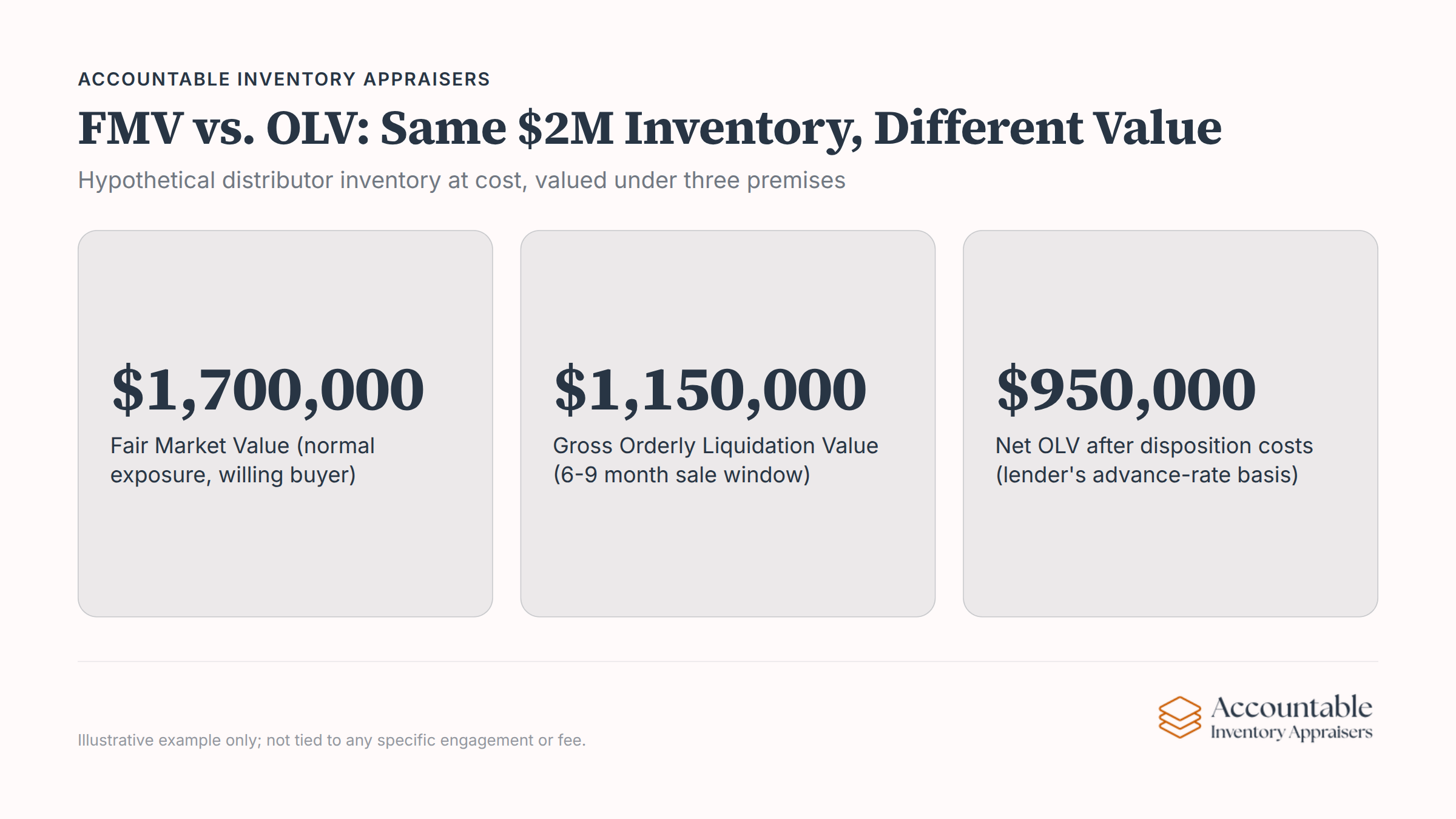
Consider a hypothetical distributor holding $2,000,000 in inventory at cost, made up of finished goods, some slower-moving stock, and a small amount of obsolete material. This example is illustrative only and isn't tied to any specific engagement or fee.
Under a fair market value premise, assuming normal market exposure and a willing, unpressured buyer, the appraiser might conclude a value of roughly $1,700,000, reflecting typical discounts for aging and partial obsolescence but assuming the goods sell through the company's ordinary channels over time.
Under an orderly liquidation value premise, assuming a 6 to 9 month window and a properly advertised, professionally managed sale, gross proceeds might be estimated closer to $1,150,000. That figure reflects the buyer's as-is purchase, the compressed marketing period, and the reduced ability to hold out for full-price buyers. After deducting estimated disposition costs (commissions, transportation, and liquidator fees), the net orderly liquidation value might land closer to $950,000, which is the number a lender would actually use to set an advance rate against that collateral.
When to Request OLV vs. FMV
The premise of value should always match the reason the appraisal exists, not the other way around. Orderly liquidation value fits situations where a compelled sale is a real possibility or an actual event:
- Asset-based lending, both at origination and during a borrowing base review
- Bankruptcy proceedings and other distressed wind-downs
- Lender workouts where a business is under financial stress but not yet liquidating
- Distressed asset sales conducted outside of a normal sale process
Fair market value fits situations where no compulsion exists and the inventory is being valued as part of an ongoing, voluntary transaction or a tax or legal requirement:
- Insurance coverage or claims involving inventory loss
- Estate and gift tax reporting
- Charitable contribution deductions for donated inventory
- Partial interest transfers, ownership changes, or partnership dissolutions, where inventory's fair market value carries the same meaning used for tax reporting under 26 C.F.R. § 1.751-1
Getting this choice right at the start of an engagement saves everyone a rework later. A report built on the wrong premise won't satisfy the reader who requested it, no matter how carefully the underlying inventory data was analyzed.
Whatever premise your situation calls for, our appraisers scope the assignment first and quote a fixed fee before work begins; engagements are never billed hourly. If you're evaluating inventory for a loan, a workout, or a distressed sale, our asset-based lending inventory appraisal service is built specifically around the orderly liquidation premise lenders expect to see.