
Blog
How Ordinary Income Property Is Appraised for Charitable Donation Deductions
Donating business inventory, self-created art, or short-term-held assets triggers a different valuation rule than typical property gifts: the deduction is capped at cost basis, not fair market value. This guide explains the IRC 170(e)(1)(A) limitation, when a qualified appraisal is actually required, and how Form 8283 applies.
Businesses and individuals who donate inventory, self-created artwork, or assets held less than a year often assume the same rules apply as any other charitable gift. They don't. Ordinary income property is subject to a specific deduction limitation under the Internal Revenue Code, and the appraisal requirements carry a nuance that trips up even experienced donors. This guide walks through how ordinary income property is valued, why the deduction is capped at cost basis rather than fair market value, and when a qualified inventory appraisal for charitable donation is actually required.
What Is Ordinary Income Property for Charitable Donation Purposes?
Ordinary income property is any donated asset that would produce ordinary income or short-term capital gain if it were sold for fair market value on the date of the gift, according to IRS Publication 526. This is a distinct legal category from the long-term capital gain property most people picture when they think of a charitable donation.
Three kinds of assets fall into this category:
- Business inventory or stock in trade. Property described under Internal Revenue Code section 1221(a)(1), meaning anything held primarily for sale to customers in the ordinary course of a trade or business.
- Self-created works. Art, manuscripts, letters, and memoranda created by the donor, or created for the donor, rather than acquired from another artist or author.
- Short-term capital assets. Any capital asset the donor has held for one year or less at the time of the gift.
Our inventory appraisal guide covers how appraisers approach business inventory more broadly; the distinction that matters for charitable giving is what category the property falls into, because that category determines how much of the value is actually deductible.
The IRC 170(e)(1)(A) Basis Limitation: Why the Deduction Isn't Full Fair Market Value
For ordinary income property, the deduction must be reduced by the amount of gain that would not have been long-term capital gain if the property had been sold at fair market value, a rule set out in 26 U.S.C. section 170. In practice, this reduction usually caps the allowable deduction at the property's cost basis, its adjusted basis, rather than its current market value.
That is the opposite of how the rule works for appreciated long-term capital gain property, where a donor can generally deduct full fair market value, subject to adjusted gross income percentage limits. Ordinary income property gets no benefit from appreciation. The deduction stops at what the donor paid or invested.
Example: A furniture retailer donates showroom inventory with a cost basis of $10,000 and a current fair market value of $25,000 to a qualifying charity. Because this is inventory (ordinary income property), the deduction is limited to the $10,000 basis, not the $25,000 market value, under the IRC 170(e)(1)(A) reduction rule described in IRS Publication 526.
The table below summarizes how this plays out across the three common scenarios donors and their advisors encounter.
| Property Type | What It Includes | Deduction Amount | Appraisal Requirement Over $5,000 |
|---|---|---|---|
| Ordinary income property: literal inventory | Business stock held for sale under section 1221(a)(1) | Limited to cost basis | Not required for the inventory itself; Form 8283 Section B still generally required |
| Ordinary income property: other | Self-created art, manuscripts, letters, memoranda, or capital assets held 1 year or less | Limited to cost basis | Qualified appraisal required, same as any other property |
| Long-term capital gain property | Capital assets held more than 1 year that have appreciated | Full fair market value, subject to AGI percentage limits | Qualified appraisal required |
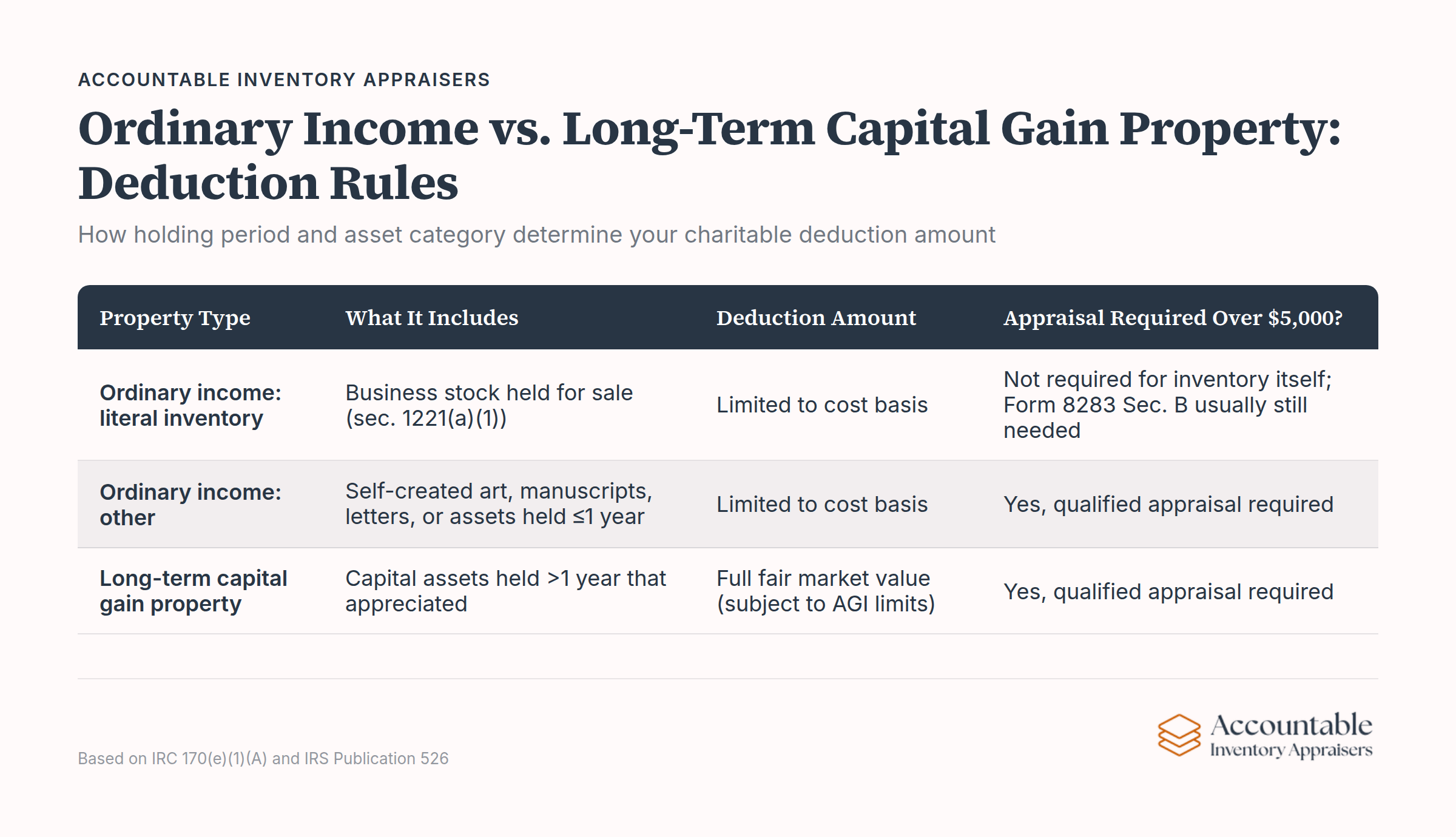
Key takeaway: Holding period and asset category, not the item's current value, determine whether a donor deducts basis or full fair market value. Getting this classification wrong is one of the most common errors on noncash contribution returns.
Does an Ordinary Income Property Donation Require a Qualified Appraisal?
This is the part of the rule that catches people off guard, and it does not have a single blanket answer. It depends on exactly what kind of ordinary income property is being donated.
IRS Publication 561 specifically states that a qualified appraisal is not required for donations of inventory and other similar property described in section 1221(a)(1), even when the claimed deduction exceeds $5,000. That carve-out applies narrowly to literal business inventory, stock in trade held for sale to customers.
That exemption does not extend to other forms of ordinary income property. Self-created works of art, manuscripts, letters, memoranda, and capital assets held one year or less do not qualify for the inventory carve-out. Once the claimed deduction for those assets exceeds $5,000, a qualified appraisal prepared by a qualified appraiser is required, the same as it would be for any other donated property.
Watch out: Donors sometimes assume that because their donated property produces an ordinary income deduction, no appraisal is ever needed. That is only true for literal 1221(a)(1) inventory. A self-created sculpture or a short-term-held collectible still needs a qualified appraisal above the $5,000 threshold.
Enhanced Deduction for C Corporation Inventory Donations
A separate provision, IRC section 170(e)(3), allows an enhanced deduction when a C corporation donates inventory to a charity that uses the property to care for the ill, the needy, or infants, and the use is related to the donee's exempt purpose with no exchange of money, property, or services in return. Where the general rule caps an ordinary income property deduction at basis, this enhanced rule allows a business to deduct more.
The formula is cost basis plus one half of the appreciation, and the total deduction cannot exceed two times the cost basis.
Example: A wholesaler donates inventory with a $10,000 basis and a $16,000 fair market value to a qualifying charity that distributes the goods to families in need. The appreciation is $6,000, so the enhanced deduction equals $10,000 plus half of $6,000, or $13,000. That amount stays under the $20,000 cap (two times basis), so the full $13,000 is deductible.
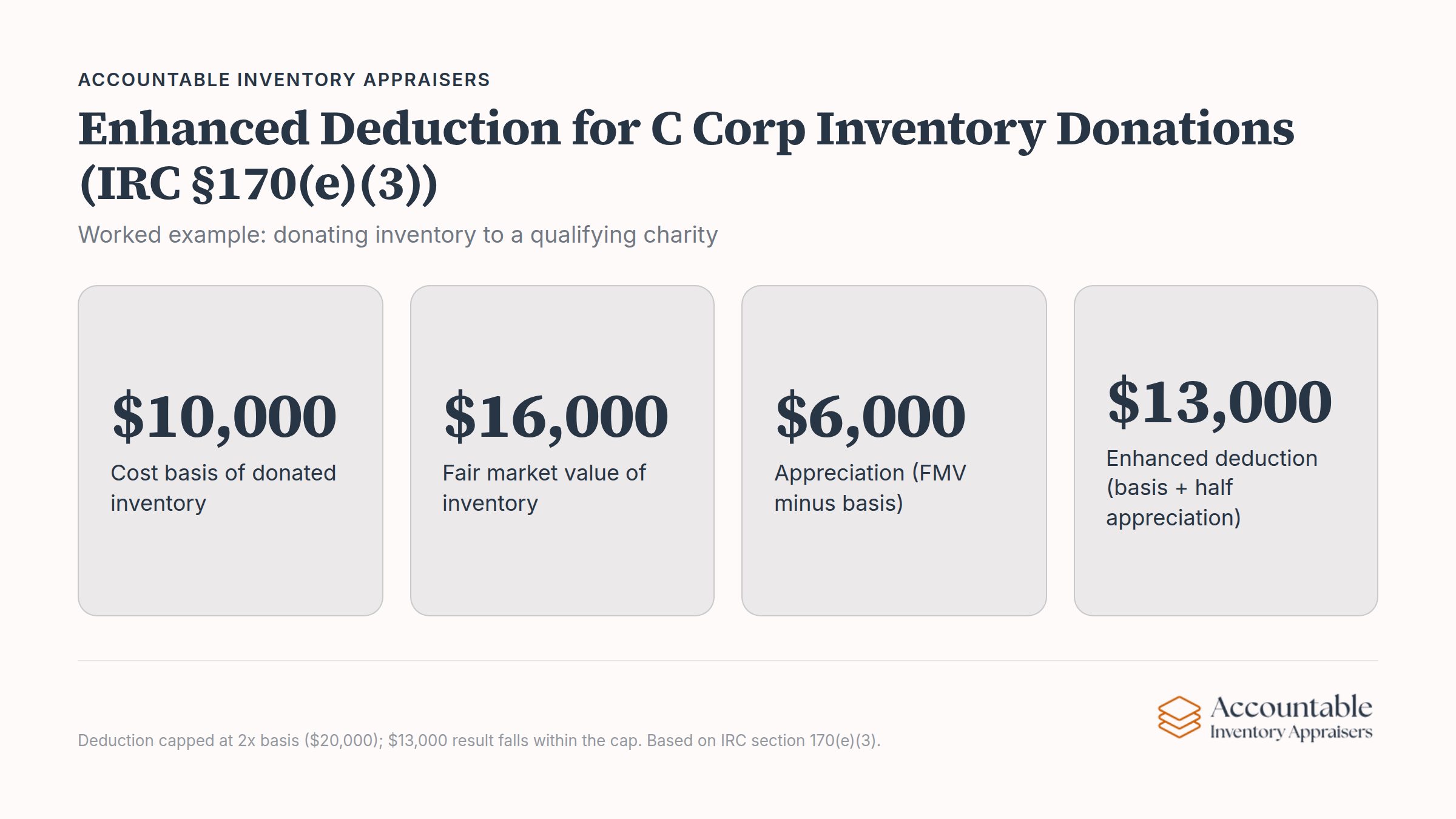
This enhanced deduction is governed by IRC section 170(e)(3) and applies only to C corporations donating to qualifying donees for the specified uses; it does not apply to individual donors or to inventory donated for general resale.
Form 8283 Requirements When the Deduction Exceeds $5,000
Whether or not a qualified appraisal is required, Form 8283 Section B is generally required for any noncash contribution where the claimed deduction exceeds $5,000, per Publication 561's general reporting rule. That includes literal inventory donations, even though the inventory itself is exempt from the appraisal requirement.
When a qualified appraisal is required, several mechanics apply:
- Signatures. Section B must be signed by the donor, by the qualified appraiser, and by an authorized official of the donee organization.
- Per-item documentation. A separate qualified appraisal and Form 8283 are generally required for each donated item, except that items that are part of a group of similar items can share a single appraisal and a single form, provided all required information is included for each item.
- Timing. The qualified appraisal must be received before the due date, including extensions, of the tax return on which the deduction is first claimed.
Missing any of these mechanics is a common reason noncash contribution deductions get challenged, independent of whether the underlying value was reasonable.
Why Professional Valuation Still Matters for Business Inventory Donations
Even when a qualified appraisal is not IRS-mandated for straight inventory, a business still needs a defensible, well-documented fair market value determination. The IRS can still ask a donor to substantiate the value used in the deduction calculation, and a company that only has an internal cost sheet or a rough estimate has little to point to if that happens.
Our appraisers hold credentials with organizations such as the ISA, ASA, and AAA, and every valuation we prepare is built in accordance with USPAP so it holds up to scrutiny regardless of whether a qualified appraisal is technically mandated. For inventory, self-created works, and short-term-held assets, that means documenting the methodology, the market data, and the basis calculation clearly enough that a CPA or attorney can rely on it when the return is filed.
Pro tip: If a business donates inventory regularly, keeping a standing, current fair market value methodology on file, rather than reconstructing one after the fact, makes each year's Form 8283 filing faster and more defensible.
Our team prepares fair market value determinations and, where required, IRS-qualified appraisals for inventory, self-created works, and other ordinary income property donations, delivered as a fixed fee quoted after we scope the assignment. Request an appraisal to get a defensible value determination in place before your return is due.
This article is provided for general informational purposes only and does not constitute legal, tax, or financial advice. Readers should consult a qualified attorney or CPA regarding their specific circumstances.