
Blog
Which States Still Tax Business Inventory for Property Tax Purposes?
Most states exempt business inventory from property tax entirely, but seven still tax most of it and several others tax it only in certain localities. This guide maps out exactly where your inventory stands and when a market-value appraisal, not a book-value number, becomes the document you need.
Property tax on business inventory is one of those rules that varies so much by state and county that business owners routinely get it wrong in both directions: some pay a tax they could have avoided, and others skip a filing they actually owed. The short answer is that most states exempt business inventory from tangible personal property (TPP) tax entirely, but a meaningful minority still tax most or all of it, and a few more tax it only in certain counties or cities. We prepare inventory appraisal services for businesses navigating exactly this kind of jurisdiction-by-jurisdiction uncertainty, and even when your inventory is exempt from property tax, you may still need a defensible valuation for insurance coverage, financing, or another business purpose.
Most States Exempt Business Inventory, But a Minority Still Tax It
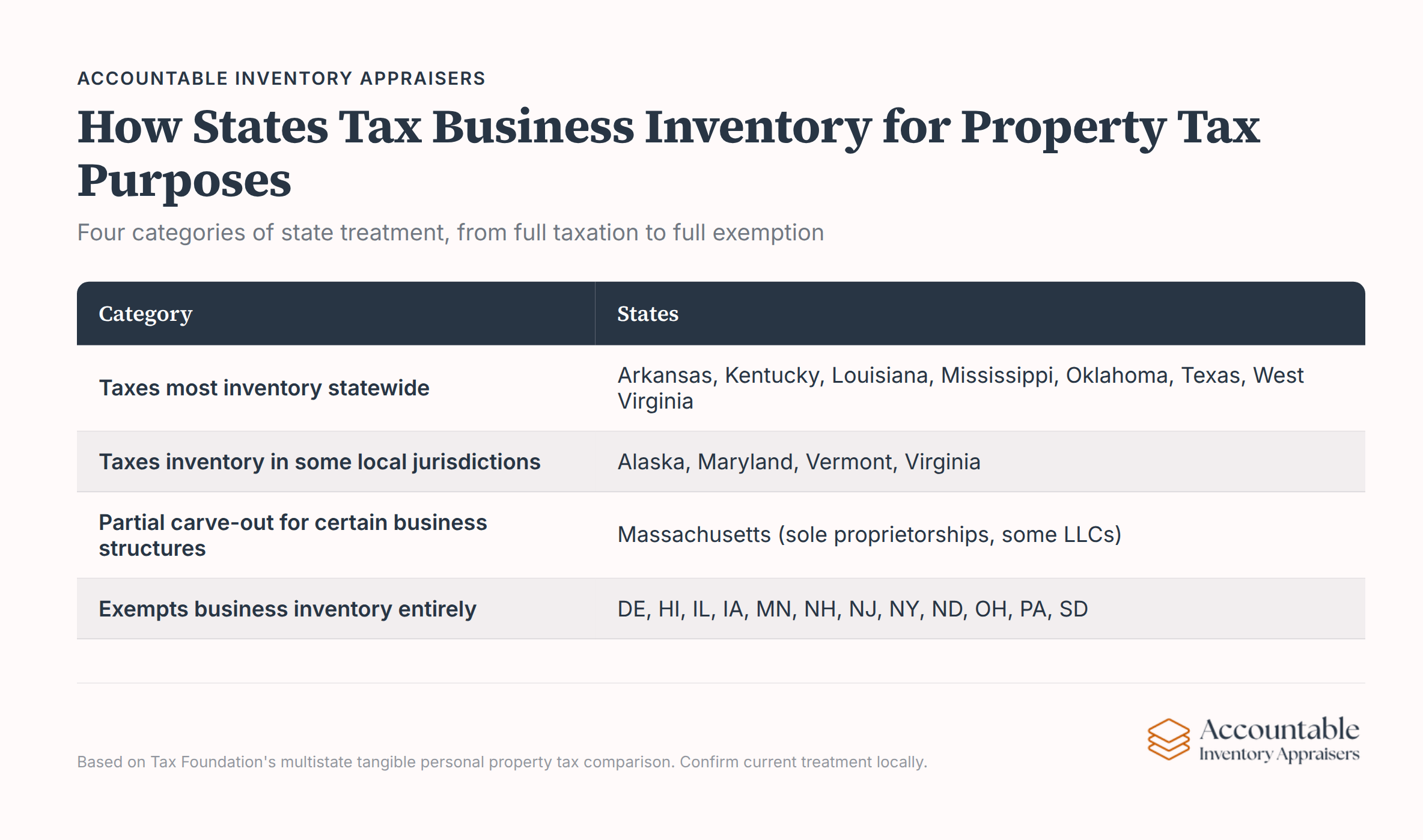
The majority of states have removed business inventory from their property tax base, but roughly a dozen states still tax it in some form, whether statewide, locally, or through a narrower carve-out. A multistate comparison of tangible personal property taxes groups the states into four practical categories, summarized below.
| Category | States |
|---|---|
| Taxes most business inventory statewide | Arkansas, Kentucky, Louisiana, Mississippi, Oklahoma, Texas, West Virginia |
| Taxes inventory only in some local jurisdictions | Alaska, Maryland, Vermont, Virginia |
| Partial carve-out for certain business structures | Massachusetts (sole proprietorships and some LLCs) |
| Exempts business tangible personal property, including inventory | Delaware, Hawaii, Illinois, Iowa, Minnesota, New Hampshire, New Jersey, New York, North Dakota, Ohio, Pennsylvania, South Dakota |
This is a useful starting map, but it is not the end of the research. Even within an "exempt" state, local jurisdictions sometimes carve out exceptions for leased equipment, consigned goods, or centrally assessed industries. Always confirm current treatment with your state revenue department or local appraisal district before assuming either side of the line.
States That Tax Most Business Inventory Statewide
Seven states still generally include business inventory in their property tax base: Arkansas, Kentucky, Louisiana, Mississippi, Oklahoma, Texas, and West Virginia. In these states, raw materials, work in process, finished goods, and in some cases packaging and supplies are all treated as taxable tangible personal property unless a specific statutory exemption applies.
Louisiana is a clear example of the general rule. Tangible personal property located in the state is subject to ad valorem taxation unless an exemption applies, and no blanket inventory exemption exists under Louisiana law. Arkansas works similarly: the state taxes raw materials, work in process, finished goods, supplies, and packaging, though a legislative proposal to repeal Arkansas's inventory tax confirms the current law excludes inventory in transit and goods manufactured in Arkansas and stored for shipment out of state.
Texas deserves its own section, both because it is the largest economy on this list and because its exemption mechanism works differently from a simple statewide rule. Our Texas inventory appraisers regularly work with businesses sorting through exactly this question.
Texas Inventory Tax Exemption: Why Location Still Matters
In Texas, business inventory is generally appraised and taxed as business personal property at market value, meaning the price it would bring selling as a unit to a buyer who intends to continue the business, and it must be reported annually through a rendition filed with the local appraisal district. A Texas inventory tax exemption does exist, commonly called the freeport exemption, which covers qualifying goods acquired in or brought into Texas and then detained in the state for 175 days or less for assembly, manufacturing, processing, or forwarding.
The catch is that the freeport exemption is a local option. Individual taxing units, not the state as a whole, must affirmatively adopt it. That means two businesses holding identical inventory in two different Texas counties can face entirely different tax outcomes depending on whether their local taxing units opted in. Absent the freeport exemption or another applicable exemption, Texas taxes inventory at its full appraised value with no automatic statewide discount.
States That Tax Inventory Only in Some Local Jurisdictions
Four states fall into a middle category: Alaska, Maryland, Vermont, and Virginia do not impose a uniform statewide inventory tax, but individual counties or municipalities within these states may still tax it. A business operating in more than one of these states cannot assume its treatment in one county will match another county across the state line, or even a few miles down the road within the same state. The only reliable way to confirm status is to check with the specific local assessor where the inventory physically sits on the assessment date.
Massachusetts' Partial Carve-Out for Sole Proprietors and LLCs
Massachusetts generally exempts corporate-owned tangible personal property from local property tax, but the exemption has not been extended evenly across every business structure. Inventory held by a sole proprietorship, and in some cases certain LLCs, has not been exempted from the state's tangible personal property tax. This means two businesses selling identical goods in the same Massachusetts town can face different property tax outcomes purely because of how one of them is legally organized. Business owners structuring or restructuring an entity in Massachusetts should treat this as a genuine planning variable, not a footnote.
States That Exempt Business Personal Property Entirely
A dozen states go further than simply exempting inventory: they exempt business tangible personal property as a category, which removes inventory from the tax base along with most other business equipment. Delaware, Hawaii, Illinois, Iowa, Minnesota, New Hampshire, New Jersey, New York, North Dakota, Ohio, Pennsylvania, and South Dakota all fall into this group. If your business operates only in one of these states, property tax is simply not a reason to commission an inventory valuation, though other reasons for one may still apply, which we cover below.
Other States That Exempt Inventory Specifically, Even While Taxing Other Business Property
A separate group of states draws a narrower line: they tax business personal property generally but carve inventory held for sale out of the base specifically. California is the clearest example. The California State Board of Equalization confirms that business inventory, while technically personal property, is 100 percent exempt from taxation, including goods that become part of a product and goods held for sale or lease in the ordinary course of business.
Florida and Nebraska take a similar, statute-based approach. Florida law exempts items of inventory from ad valorem taxation outright, a rule set out in the Florida Statutes governing property tax exemptions. Nebraska's statute is similarly direct: business and agricultural inventory are expressly exempt from personal property tax under Nebraska Revised Statutes § 77-202, though the same statute pulls certain leased or rented property back into the taxable definition of inventory under specific conditions. The lesson across all three states is the same: an inventory exemption does not automatically extend to equipment, furniture, leased property, or supplies. Read the exemption's exact scope rather than assuming it covers everything on the balance sheet.
Why a Taxable Inventory Still Needs a Market-Value Appraisal
If your state or locality taxes inventory, the taxing authority needs a defensible, supportable value, not a cost-basis figure copied out of your accounting system. Book value reflects what you paid for goods and how your accounting method amortizes that cost over time. It does not reflect what the inventory would actually sell for as of the assessment date, which is the standard most taxing jurisdictions actually apply.
Pro tip: If you are protesting an assessor's inventory value, you generally need your own independent valuation to support the appeal. A number pulled from your general ledger, without market support, rarely holds up on its own.
Our appraisers prepare inventory valuations in accordance with the Uniform Standards of Professional Appraisal Practice published by The Appraisal Foundation, and hold credentials with organizations including the ASA, ISA, and CAGA. We quote every engagement as a fixed fee after scoping the assignment, based on the number of SKUs, the quality of existing records, and the complexity of the inventory itself, never as a percentage of value and never billed hourly.
If Your State Exempts Inventory, You May Still Need a Valuation
Exemption status removes the property tax reason for an appraisal, but it does not remove every reason. Businesses in fully exempt states still commission inventory appraisals for insurance coverage and claims, asset-based lending and borrowing-base calculations, charitable donations of excess or discontinued inventory, estate and litigation matters, and mergers or acquisitions where a buyer wants an independent number rather than the seller's book figure. The exemption only tells you property tax is off the table; it says nothing about whether a lender, insurer, or the IRS will accept a cost-basis number in its place.
Watch out: Property tax rules change, and local adoption of exemptions like Texas's freeport exemption can shift from year to year. Treat any state-by-state list, including this one, as a starting point for your own confirmation with the relevant state revenue department or local appraisal district, not as a final legal determination.
If you are unsure whether your inventory is taxable where you operate, or you need a supportable value to file a rendition, protest an assessment, or satisfy a lender or insurer, our team can scope a fixed-fee inventory appraisal built around your specific jurisdiction and purpose.
This article is provided for general informational purposes only and does not constitute legal, tax, or financial advice. Readers should consult a qualified attorney or CPA regarding their specific circumstances.