
Blog
How Statistical Sampling and Confidence Intervals Shape Large Inventory Appraisals
Statistical sampling for inventory appraisal lets appraisers value warehouses and retail lots holding thousands of SKUs without counting every unit, using stratified samples and calculated confidence intervals to reach a defensible value conclusion.
When a distribution center holds 40,000 SKUs across three warehouses, nobody is counting and inspecting every box. Statistical sampling for inventory appraisal is how appraisers, auditors, and lenders reach a defensible value conclusion on large lots without touching every unit. This matters to any business owner, CPA, attorney, or lender relying on an inventory valuation for a loan, an insurance claim, a bankruptcy proceeding, or a tax filing, because the credibility of the final number depends on how the sample behind it was built.
Why Appraisers Sample Instead of Counting Every Unit
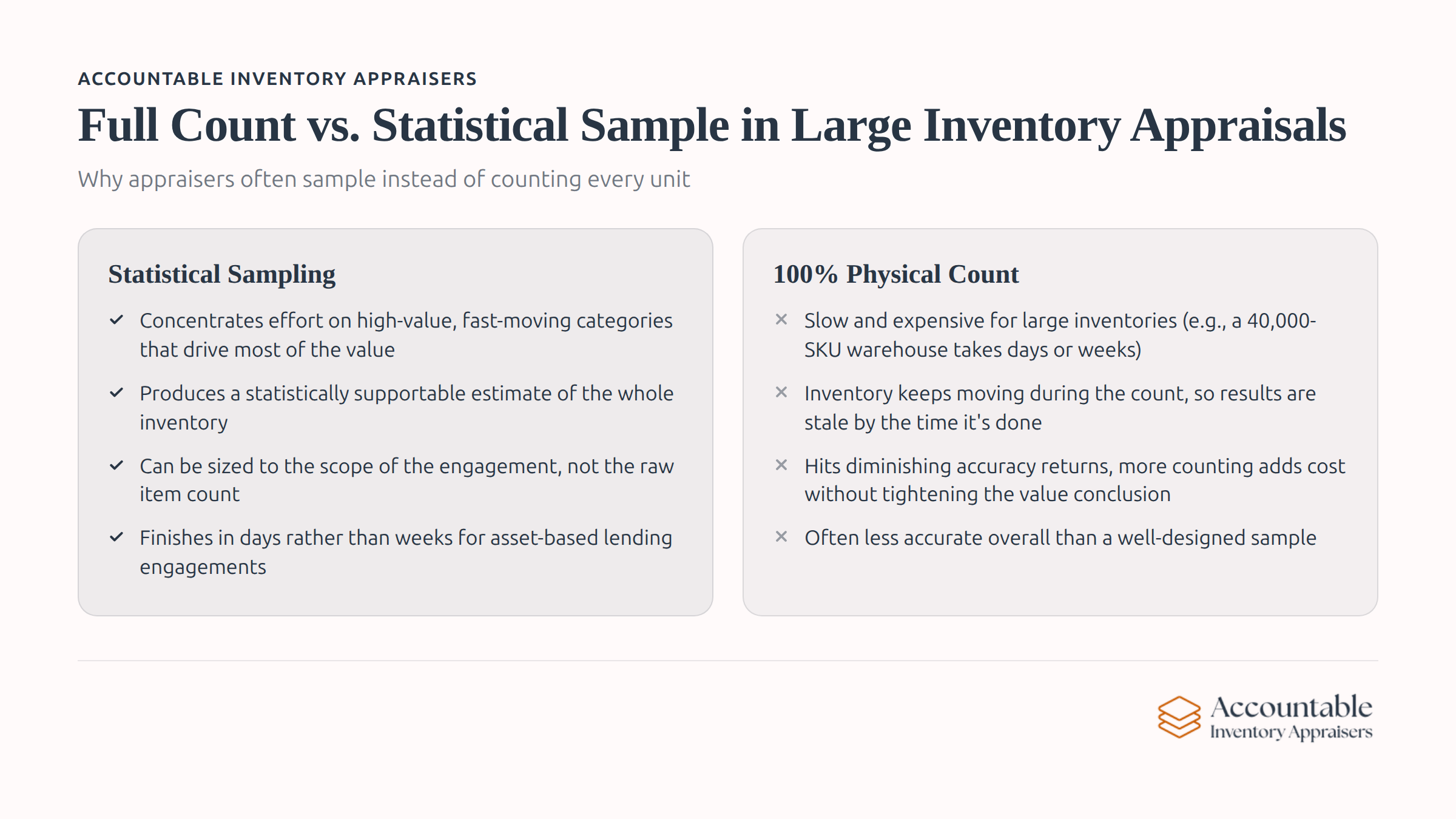
A 100% physical count of a large inventory is slow, expensive, and often less accurate than a well-designed sample. Counting every item in a 40,000-SKU warehouse can take a crew days or weeks, during which the inventory keeps moving: items ship, arrive, get relocated, or get damaged, so a count that starts on Monday is already stale by Friday. Beyond the time and labor cost, full counts run into diminishing accuracy returns: past a certain point, more counting adds cost without meaningfully tightening the value conclusion, because the bulk of the value sits in a relatively small number of high-value or fast-moving categories.
A properly designed sample, by contrast, concentrates effort where it matters most and still produces a statistically supportable estimate of the whole. This is the same logic that lets our inventory appraisal team size an engagement to the scope of the assignment rather than to the raw item count. For a business preparing for an asset-based lending engagement, that distinction between a full count and a rigorous sample can be the difference between a valuation finished in days versus weeks.
Random Sample Counting: Verifying Quantities Against Records
Sample counting is the process of randomly selecting individual inventory items and physically verifying their on-hand quantities against the company's own records. The appraiser is not trying to recount the whole warehouse; the goal is to test whether the records the company provided can be trusted as a basis for the value conclusion.
If the sampled counts match company records closely, or any discrepancies can be reasonably explained, the appraiser can state a professional belief that the underlying inventory data is reasonable. If the sample turns up material discrepancies, that is a signal to expand the sample, investigate further, or qualify the report accordingly. This is consistent with how IRS examiners are directed to evaluate sampling plans in their own review work: the design has to be statistically valid, execution has to match the plan, and the results have to be evaluated for what they actually show about the population.
Sample Testing: Checking Condition, Saleability, and Obsolescence
Counting confirms quantity. Sample testing confirms value. Once an appraiser has reasonable confidence in the reported quantities, individual line items or SKUs within the sample get examined for the characteristics that actually drive value: condition, saleability, seasonality, and obsolescence risk.
A case of unopened, in-season merchandise and a case of damaged, discontinued stock might carry an identical unit count on the books but very different values. Sample testing is where the appraiser catches that difference and builds it into the value conclusion, rather than assuming every unit in a category is worth the same amount simply because the inventory ledger says so.
Stratification by Category, Value, and Velocity
A random sample pulled evenly across an entire inventory tends to waste attention on low-value, slow-moving stock while under-sampling the smaller number of items that carry most of the dollar value. Stratification solves this by dividing the inventory into groups, commonly by product category, unit value, and sales velocity, before sampling within each group.
High-value or fast-moving strata get proportionally more sampling attention, since errors there have a bigger effect on the final value conclusion. Slow-moving or low-value strata still get sampled, just less intensively. This is the same principle behind the ABC method of classifying inventory, where a small share of SKUs typically accounts for the majority of value and deserves the tightest scrutiny. Auditing literature describes comparable techniques, including monetary unit sampling, which weights selection toward higher-value items, and multilocation sampling approaches for inventory spread across several sites or warehouses, both of which are documented in professional audit sampling guidance.
Sample Size and Representativeness: What Actually Drives Reliability
Randomness alone does not make a sample reliable. A random sample that is too small, or that happens to miss an entire category or location, can still produce a misleading result. Reliability depends on three things working together: the sample has to be random, it has to be large enough relative to the size and variability of the population, and it has to actually represent every meaningful segment of the inventory (every category, value tier, and location).
Professional sampling guidance frames this as a planning exercise with explicit inputs: an appraiser sets a target confidence level, an acceptable margin of error, and, where known, the size of the population, and those choices drive the required sample size before any counting begins. A larger, more variable inventory generally needs a larger sample to hold the same margin of error; a smaller or more uniform inventory can be supported with less.
What Margin of Error and Confidence Interval Mean for Your Valuation
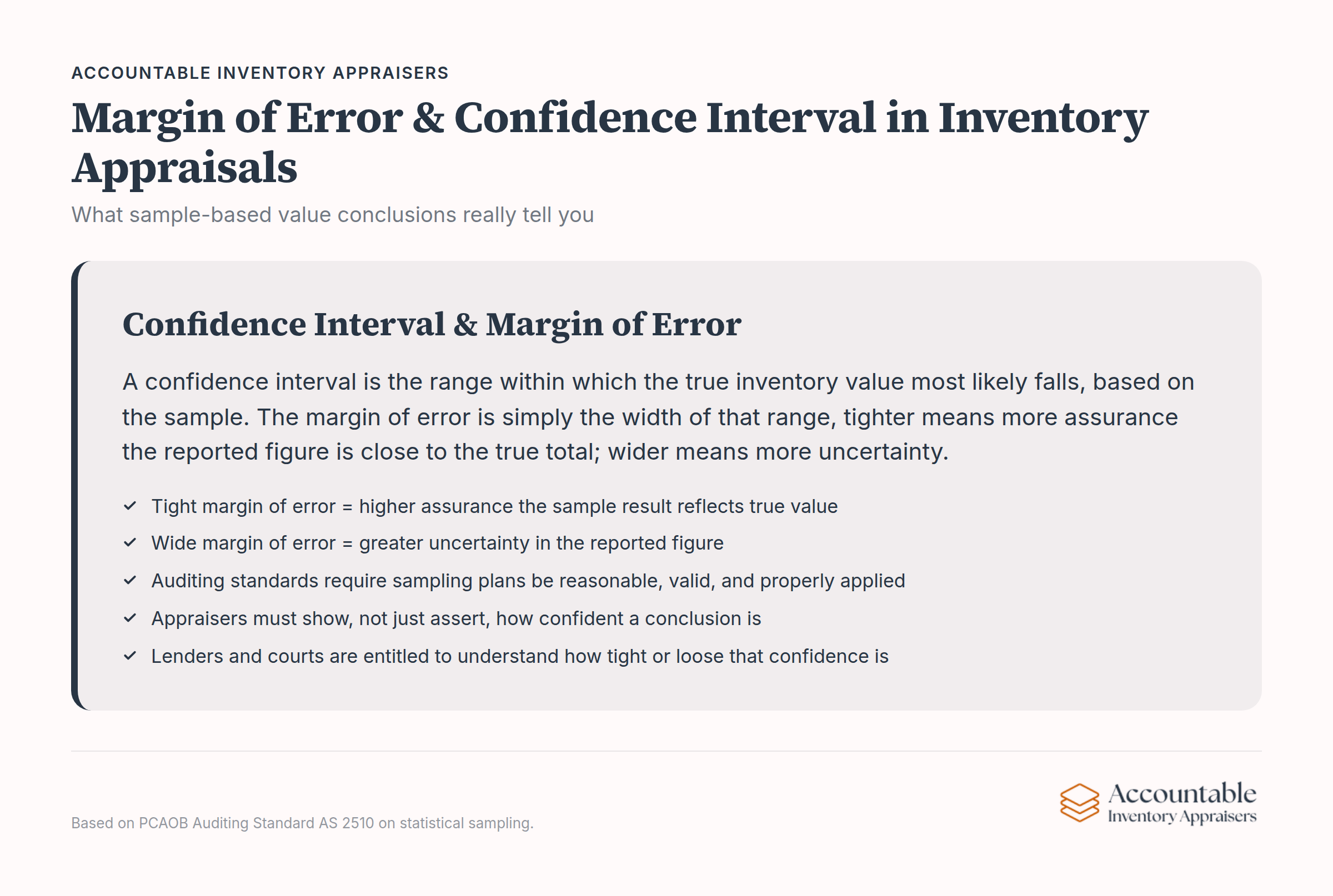
A confidence interval is simply the range within which the true inventory value most likely falls, based on what the sample showed. A margin of error is the width of that range. If a sample supports a value conclusion with a tight margin of error, the appraiser has more assurance that the reported figure is close to the true total; a wider margin means more uncertainty around that same number.
These are not abstract statistics. Auditing standards require that when statistical sampling is used, the sampling plan must be reasonable and statistically valid, properly applied, and produce reasonable results, which in practice means the appraiser has to be able to show, not just assert, how confident the conclusion is and why. A lender reviewing an asset-based lending report, or a court reviewing a bankruptcy valuation, is entitled to understand how tight or loose that confidence really is.
The USPAP Disclosure Requirement for Sampling as an Extraordinary Assumption
When an appraisal relies on a sample rather than a full count, the assumption that the sample is representative and fair is an extraordinary assumption, and it has to be disclosed as one. Under USPAP, Standards Rule 1-2(f) requires the appraiser to identify any extraordinary assumptions used in the assignment, and Standards Rule 2-2 requires the report to clearly and conspicuously disclose those assumptions and note that they may have affected the assignment results.
In practice, this means a sampling-based inventory appraisal should include plain language telling the reader that the conclusion rests on the assumption that the sample taken is representative and fair, and that no warranty is given that this is in fact the case. This is not boilerplate. It is the mechanism that keeps a statistically sound sample from being mistaken for a certainty the appraiser cannot actually claim.
Watch out: A report that uses sampling but never discloses it as an extraordinary assumption is missing a required disclosure, not just a nice-to-have. Any reviewer trained in USPAP will flag that gap.
Tying Quantities to Value: Level of Trade and Lower of Cost or Market
Sampling confirms what is on hand and in what condition, but a valid value conclusion still has to apply the right valuation framework on top of those quantities. Level of trade matters because the same item is worth something different depending on whether it is being valued at retail, wholesale, or liquidation levels; a sample has to be evaluated at the level of trade that fits the intended use of the appraisal.
For financial reporting purposes, the lower of cost or market (LCM) principle often governs how sampled quantities translate into a reported value, since inventory carried above its net realizable value has to be written down. A sample can be statistically sound and still produce a misleading appraisal if it is not tied to the correct valuation standard for the assignment, whether that is fair value for a financial statement, orderly liquidation value for a lender, or fair market value for a donation or estate filing.
How We Approach Sampling in Large Inventory Engagements
Large inventory appraisals call for a sampling plan that is scoped to the assignment, not a generic template applied regardless of size or complexity. Our appraisers design the stratification, set the sample parameters, and disclose the resulting extraordinary assumptions in line with USPAP before a single count begins, so the report holds up to scrutiny from a lender, a court, the IRS, or an auditor.
Fees for these engagements are quoted as a fixed amount after we scope the assignment, based on factors like the number of locations and SKUs, the quality of existing inventory records, and whether the report needs to meet a heightened standard such as an IRS-qualified appraisal. If your business is preparing for a loan, a claim, or a filing that depends on a defensible inventory number, our inventory appraisal services start with a conversation about what your sample and your report actually need to prove.
This article is provided for general informational purposes only and does not constitute legal, tax, or financial advice. Readers should consult a qualified attorney or CPA regarding their specific circumstances.