
Blog
Work in Process Inventory Valuation: Why It Carries the Steepest Liquidation Discount
Work in process inventory valuation is the hardest part of any collateral or liquidation appraisal because WIP has no market until someone finishes it. This guide explains how raw materials, WIP, and finished goods are valued differently, and what data appraisers need to analyze WIP accurately.
When a lender or restructuring advisor looks at a manufacturer's balance sheet, "inventory" reads like one line item. It isn't. Raw materials, work in process, and finished goods behave like three different asset classes once a liquidation scenario is on the table, and a collateral or liquidation appraisal has to value each one on its own terms.
Raw materials usually retain a clear market: another manufacturer or a broker can buy steel, resin, or lumber without caring who originally purchased it. Finished goods have a buyer waiting at the end of the supply chain, even if that buyer pays less in a forced sale. Work in process sits in between, and it's the category that causes the most disagreement between borrowers and lenders. Our inventory appraisal for lenders engagements, and the asset-based lending appraisals we prepare for revolving credit facilities, spend a disproportionate share of analysis time on WIP precisely because a blanket percentage applied to book cost almost never reflects what a liquidator could actually recover.
How Appraisers Value Raw Materials Inventory
Raw materials are generally valued using current replacement cost or observable market resale evidence, adjusted downward for condition, quantity on hand, and obsolescence. This is the most straightforward of the three categories because raw materials typically do not require any further manufacturing step before they can change hands.
A steel coil, a roll of fabric, or a drum of resin can usually be sold to another producer who uses the same input, or to a broker who handles that commodity. The appraiser's job is to confirm current market pricing for materials of comparable grade and specification, then deduct for any quantity that is slow-moving, discontinued, or tied to a customer-specific formulation that limits its resale pool. Because raw materials sit closest to a cash market, they generally receive the gentlest liquidation discount of the three inventory categories.
What Makes Work in Process Inventory Valuation So Difficult
Work in process inventory valuation is difficult because WIP usually has no independent market in its current state. Generally accepted accounting fair value guidance frames WIP value as the estimated selling price of the finished product, less the remaining cost to complete it, less costs of disposal, and less a normal profit allowance for whoever does the finishing and selling work, as described in Deloitte's accounting guidance on inventory fair value.
That top-down framework sounds simple, but every input requires judgment. What will the finished unit actually sell for once it's done, especially in a distressed sale? What labor, outside processing, tooling, and testing remain? Does the party completing the goods have the equipment, technical know-how, and customer approvals to do it? A partially machined part, a half-assembled subsystem, or a garment cut but not sewn can carry a substantial accounting cost while being worth very little to anyone who isn't already set up to finish it.
Pro tip: Don't assume WIP near completion behaves like WIP at an early stage. A unit that's 90% through its routing with only final inspection remaining is a fundamentally different risk than a unit that's had raw material issued but no labor applied. Appraisers segment WIP by stage of completion for exactly this reason.
Why Work in Process Carries the Steepest Liquidation Discount
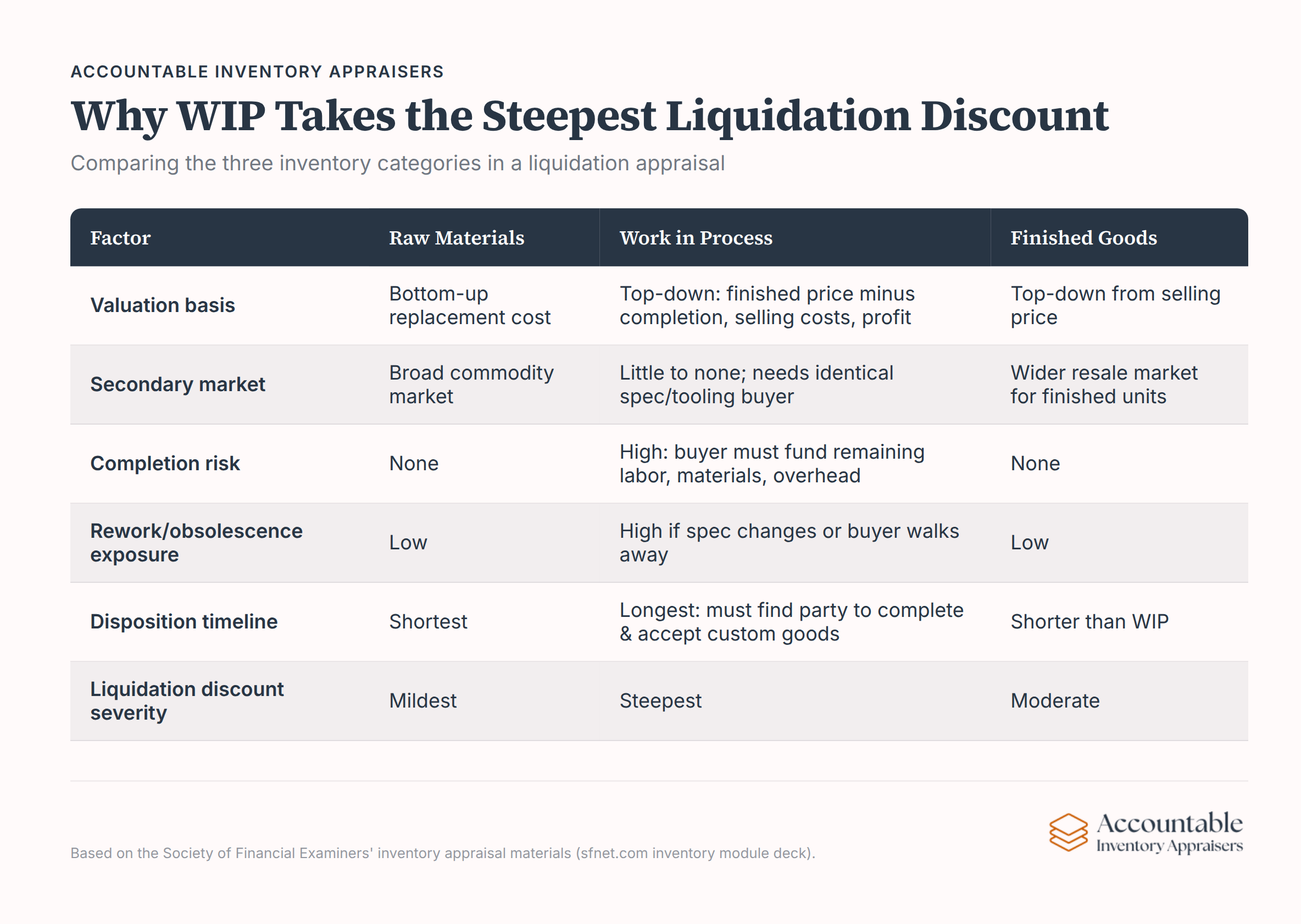
Work in process carries the steepest liquidation discount of the three inventory categories because it combines completion risk, a narrow secondary market, and the longest disposition timeline. Several factors stack against WIP at once.
- Completion funding risk. Someone has to pay for the remaining labor, materials, and overhead before WIP becomes sellable, and that party demands compensation for taking on the risk that completion costs run higher than expected.
- Little to no secondary market. Unlike raw materials, a partially finished part generally cannot be sold to a different manufacturer unless that buyer uses the identical specification and tooling, which is uncommon.
- Rework and obsolescence exposure. If a customer order changes, a specification is revised, or the original buyer walks away, in-process goods built to that exact spec may need rework or may lose most of their value outright.
- Longer disposition timeline. Finding a party willing to complete and accept custom or semi-custom WIP, negotiate terms, and execute the remaining production steps takes materially longer than liquidating a stack of finished units or a pallet of raw commodity material.
The Society of Financial Examiners' inventory appraisal materials describe this as a top-down analysis starting from the expected finished-goods selling price and working backward through completion costs, selling costs, and a profit allowance, which is a different calculation path than the bottom-up, replacement-cost approach used for raw materials. The result is that two inventory lines with identical book value, one in raw materials and one in WIP, can produce very different recovery figures in a liquidation appraisal.
How Appraisers Value Finished Goods Inventory
Finished goods are valued top-down, starting from the expected selling price and deducting selling and disposal costs plus a reasonable profit allowance for the party conducting the sale. Market comparables, open customer orders, and sales backlog all inform that starting selling-price assumption.
Finished goods generally receive the strongest recovery assumption of the three categories because they require no further manufacturing and can usually move through existing distribution channels, even at a discount. That said, liquidation conditions still matter. Age, seasonality, packaging condition, and the volume being dumped into the market at once all affect how close the liquidation price lands to the normal selling price. A warehouse of current-season finished goods with active customer orders behaves very differently from a warehouse of discontinued SKUs nobody has ordered in a year. Industry discussion of inventory valuation issues in distressed situations makes the same point about separating current, in-demand finished goods from aged or obsolete stock before applying a recovery assumption.
Raw Materials vs. WIP vs. Finished Goods: A Side-by-Side Comparison
The table below summarizes how the valuation basis, typical market, and discount severity shift across the three inventory categories in a collateral or liquidation appraisal.
| Category | Valuation Basis | Typical Market | Discount Severity |
|---|---|---|---|
| Raw materials | Current replacement cost or market resale price | Other manufacturers, commodity brokers | Lightest |
| Work in process | Finished-goods selling price, less cost to complete, disposal costs, and profit allowance | Narrow; often limited to parties who can complete the specific item | Steepest |
| Finished goods | Expected selling price, less selling/disposal costs and profit allowance | Existing distribution channels, secondary liquidators | Moderate, depends on age and obsolescence |
What Data Appraisers Request to Analyze WIP
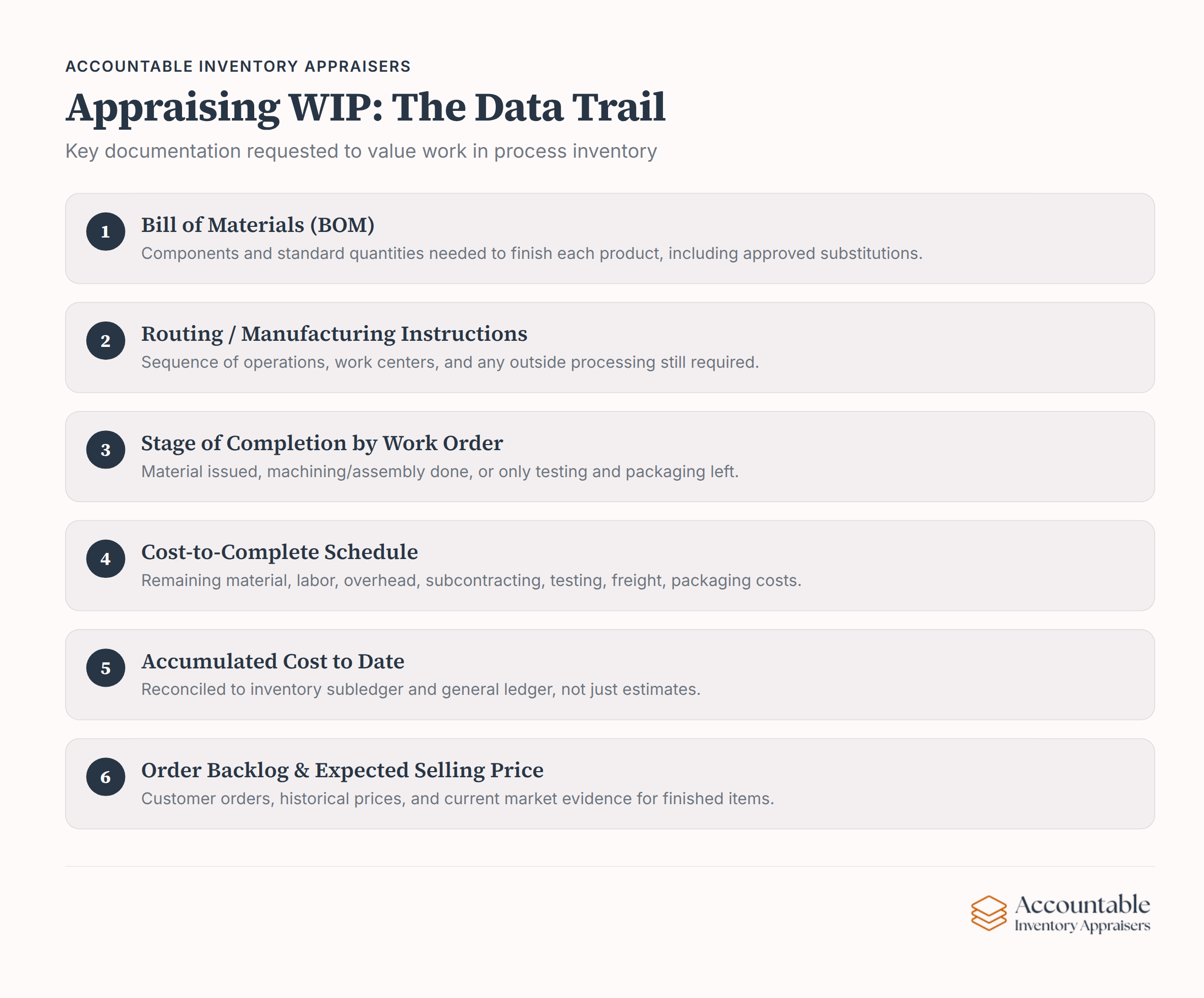
A defensible work in process inventory valuation depends on item-level operational data, not a general-ledger total. For WIP specifically, we typically request the following documentation before forming an opinion of value.
- Bill of materials (BOM): the components and standard quantities required to finish each product, including approved substitutions.
- Routing or manufacturing instructions: the sequence of operations, work centers, and any outside processing each unit still needs.
- Stage of completion by work order: whether material has been issued, machining or assembly is complete, or only testing and packaging remain.
- Cost-to-complete schedule: remaining material, direct labor, overhead, subcontracting, testing, freight, and packaging costs, broken out separately from cost already incurred.
- Accumulated cost to date: reconciled to the inventory subledger and general ledger so the appraiser isn't working from estimates alone.
- Open order backlog and expected selling price: customer orders, historical sales prices, and current market evidence for the finished item.
- Aging and obsolescence reports: flagging discontinued, customer-specific, or defective work orders that may have no completion path at all.
For raw materials and finished goods, the request list is lighter: current inventory listings by SKU with quantity and location, aging and turnover reports, and evidence of current market pricing or recent sales. The depth of documentation requested for WIP reflects how many variables feed into its valuation compared to the other two categories.
Watch out: A cost-to-complete figure pulled straight from standard cost accounting can understate real completion risk. Standard costs assume normal production conditions; a liquidation scenario often means the original labor force, tooling, or supplier relationships are no longer available, which pushes actual completion costs higher than the book estimate.
Fees Reflect Scope, Not the Value Conclusion
Inventory appraisal fees are quoted as a fixed fee once we scope the assignment, based on factors like the number of SKUs, the complexity of the WIP mix, and whether the report needs to meet lender or IRS-qualified standards, never on the dollar value the inventory ultimately appraises for. A straightforward raw materials and finished goods appraisal with clean records costs less to prepare than an engagement with heavy WIP concentration that requires BOM-level and routing-level analysis across hundreds of open work orders.
If your facility carries meaningful work in process and you need a collateral-ready liquidation analysis, a fixed-fee inventory appraisal scoped around your actual inventory mix will give both you and your lender a defensible starting point for structuring the borrowing base.
This article is provided for general informational purposes only and does not constitute legal, tax, or financial advice. Readers should consult a qualified attorney or CPA regarding their specific circumstances.