
Blog
The LIFO Conformity Rule: Can You Use LIFO for Taxes but FIFO for Books?
The LIFO conformity rule under IRC Section 472(c) bars a company from reporting FIFO income to shareholders or lenders while using LIFO on its tax return. This guide explains the real exceptions, the controlled-group trap, and why appraisers need to know which costing method is actually in force before valuing inventory.
A company that elects LIFO for its federal tax return cannot simply report FIFO earnings to its bank, its shareholders, or its board. That restriction, known as the LIFO conformity rule, is one of the most misunderstood provisions in inventory accounting, and it matters well beyond the tax department. Controllers, CPAs, and anyone performing an inventory appraisal need to know which costing method is actually in force before they can trust the numbers in front of them.
What the LIFO Conformity Rule Actually Requires
The rule comes from Internal Revenue Code Section 472(c), carried out through Treasury Regulation 1.472-2(e). It conditions a taxpayer's LIFO election on one promise: the company will not use a method other than LIFO, or a method at variance with LIFO, to determine income, profit, or loss in reports or statements covering a taxable year that go to any of the following:
- Shareholders or other owners, in reports on the results of operations.
- Partners, proprietors, or beneficiaries, where the entity is a partnership, sole proprietorship, trust, or estate.
- Creditors, including banks and other lenders, when the information is supplied for credit purposes.
This condition applies starting in the first year LIFO is adopted and continues in every year the election stays in place. An IRS practice unit covering LIFO conformity describes the requirement in plain terms: once a taxpayer is on LIFO for tax purposes, its primary financial reporting for income, profit, or loss has to tell the same story.
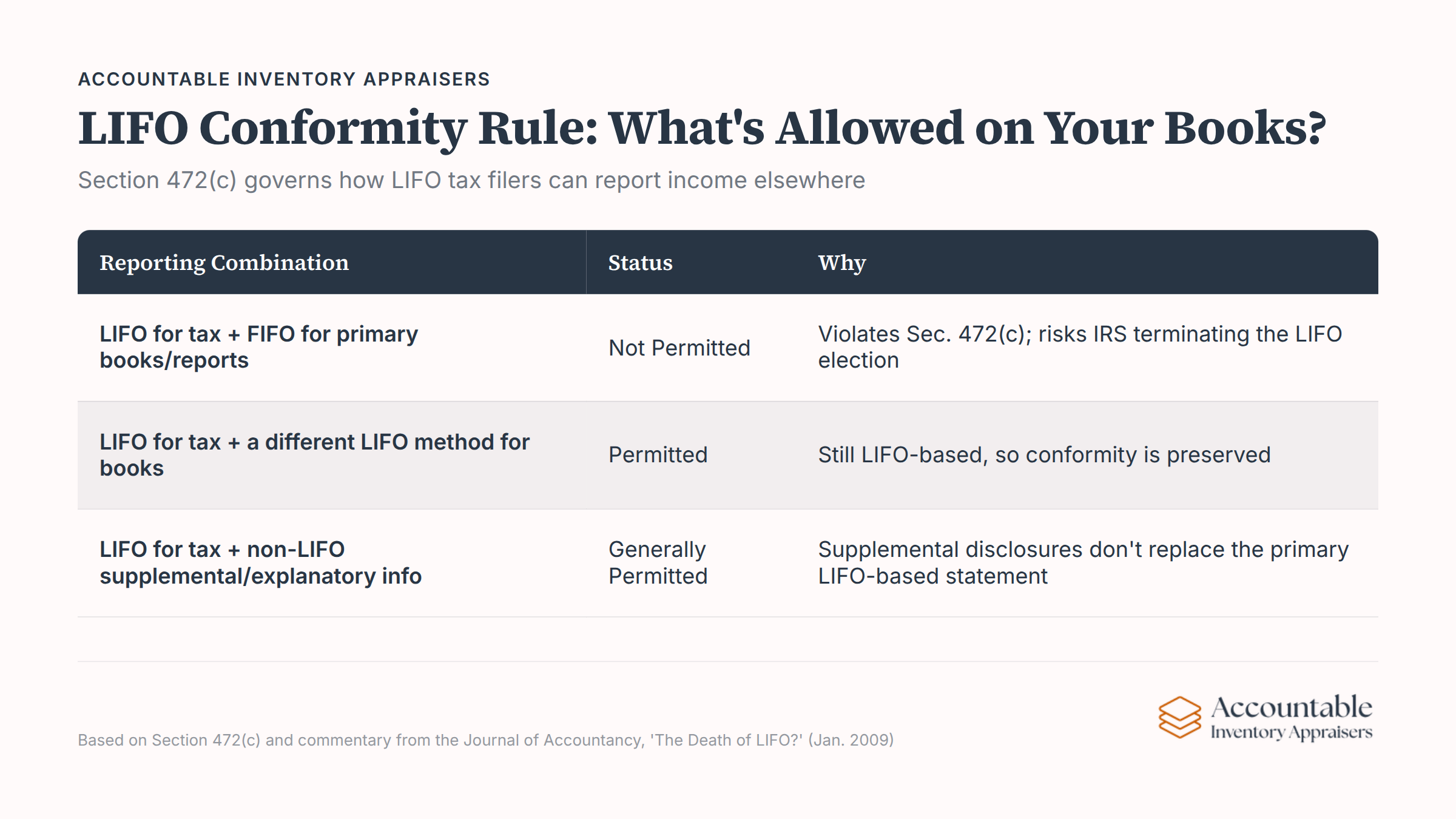
Importantly, conformity does not mean the tax computation and the book computation have to be identical. A company can use the double-extension method for its financial statements and the link-chain method for its tax return, for example, as long as both are genuinely LIFO methods. The rule targets the choice between LIFO and non-LIFO, not which flavor of LIFO is used.
What's Not Allowed: Reporting FIFO Income While Filing LIFO Taxes
A business cannot issue a primary income statement, a credit application, or an annual report built on FIFO figures while its tax return runs on LIFO. That combination is the core violation the conformity rule exists to prevent.
Example: A distributor elects LIFO for its tax return to defer income during a period of rising costs. If that same distributor then sends its bank a loan-renewal package showing FIFO-based net income because the numbers look stronger, it has violated Section 472(c), regardless of whether the bank ever finds out.
The consequence is not cosmetic. The Journal of Accountancy has explained that a conformity failure can put the company's LIFO election itself at risk, and the IRS has the authority to terminate the election if a taxpayer fails to maintain the records and computations LIFO requires. Losing LIFO unexpectedly can trigger a large recapture of previously deferred income in a single tax year, which is a far bigger problem than the paperwork mismatch that caused it.
The Real Exceptions to Conformity
The rule has genuine, narrow carve-outs, and knowing them keeps a company from being more conservative than the law requires.
- Supplemental or explanatory disclosure: A company can show what earnings would have been under FIFO in a footnote or parenthetical, as long as the primary income statement still reports on a LIFO basis and the alternate figure is clearly labeled as supplemental.
- Balance-sheet asset values: Valuing the inventory asset itself (what's sitting on the balance sheet) is treated differently from determining income, profit, or loss. A non-LIFO figure can appear as the carrying value of inventory on hand, so long as any income or profit conclusion drawn from it stays confined to a similarly limited footnote or parenthetical disclosure.
- Internal management reports: Reports generated only for use inside the company, never shared with shareholders, partners, or creditors, fall outside the rule entirely.
- Interim reports: A single report covering less than a full taxable year is generally not covered. But a series of interim reports that can be stitched together to reconstruct a full year's income is treated as covered, so quarter-by-quarter FIFO reporting that adds up to an annual FIFO picture does not escape the rule just because each piece is labeled "interim."
The thread connecting all four exceptions is the same: supplemental, internal, or partial-year information is fine, but the primary, full-year story told to owners and creditors has to match the tax return.
Controlled Groups: IRC 472(g) Treats Related Corporations as One Taxpayer
Conformity does not stop at the entity that filed the LIFO election. Under IRC Section 472(g), all members of the same group of financially related corporations are treated as a single taxpayer for conformity purposes. A parent company cannot elect LIFO at the operating subsidiary while a sister company in the same controlled group reports FIFO income to the group's lenders or investors. The IRS looks at the group's financial reporting as a whole, not entity by entity, when testing whether conformity has been honored.
This is a common blind spot in multi-entity structures built through acquisition, where different subsidiaries historically used different costing methods before being folded into a single controlled group. A conformity review after a merger or reorganization is worth doing before the next tax filing, not after an exam raises the question.
The IFRS Wrinkle for Multinational Groups
Multinational companies face a structural conflict that domestic-only businesses never see: IAS 2, the international accounting standard governing inventory, prohibits LIFO entirely. A U.S. subsidiary that elects LIFO for federal tax purposes can run straight into conformity trouble if its only primary financial statements are the IFRS-based consolidated statements prepared under FIFO or weighted-average costing for the parent group.
Groups that want to keep a U.S. LIFO tax election typically solve this by maintaining a separate U.S. GAAP reporting package that reflects LIFO, distinct from the IFRS consolidated statements used for the rest of the world. The IFRS statements serve the global reporting requirement; the GAAP/LIFO package serves the conformity requirement. Skipping that separate package, and simply pointing to IFRS numbers as the company's only financial statements, is one of the more common ways multinational groups unintentionally break conformity.
Why This Matters Before an Inventory Appraisal or Business Valuation
An appraiser cannot value inventory correctly without first knowing whether the cost figures on the books reflect current costs or old LIFO layers. LIFO cost can diverge sharply from current replacement cost during inflationary stretches, since the oldest, cheapest layers of cost stay parked on the balance sheet while current purchase prices rise.
This matters directly in a few recurring scenarios:
- Asset-based lending: A lender relying on inventory as collateral needs the net orderly liquidation value of what's actually on the shelf, not a LIFO-reduced book figure that understates current cost. Our asset-based lending inventory appraisal work starts by confirming which costing method produced the numbers on the borrowing base certificate before building an independent value conclusion.
- Business valuation and purchase price allocation: Buyers in an acquisition need to know whether target company earnings reflect LIFO-deferred income that will reverse under new ownership, and whether reported inventory values need restatement to a current-cost basis.
- Collateral and credit reporting: Since Section 472(c) specifically covers reports supplied to creditors, a lender reviewing a LIFO company's financials should expect LIFO-consistent figures, and any FIFO-equivalent data should be clearly marked supplemental rather than presented as the primary picture.
Before valuing inventory for any of these purposes, our appraisers confirm which costing method is actually driving the reported numbers. Getting that wrong can push a valuation materially off target in either direction, understating replacement cost in a rising-price environment or overstating it if LIFO reserves have already been worked down.
Keeping Tax and Book Reporting in Sync
The LIFO conformity rule is narrower than many companies assume: it targets the primary story told to owners and creditors, not every internal number or footnote a company produces. A company can disclose supplemental FIFO-equivalent earnings, value inventory assets separately from income, and run internal reports however it likes. What it cannot do is hand its bank or shareholders a FIFO income statement while filing LIFO with the IRS, and it cannot sidestep that rule by splitting one company's results across several related entities in a controlled group.
For anyone relying on a LIFO company's financials, whether for a loan decision, a merger, or an inventory appraisal for lending collateral review, the first question is always which costing method actually produced the number in front of them.
This article is provided for general informational purposes only and does not constitute legal, tax, or financial advice. Readers should consult a qualified attorney or CPA regarding their specific circumstances.